How to Fill a Deep Corten Steel Planter Without Using Too Much Soil
Date:2026.11.19
Share to:
Tall corten steel planters make a striking visual impression, but they do not need to be filled with potting soil from bottom to top. For many plants with shallow root systems, it is sufficient to reserve enough growing medium in the upper layer, while the lower half of the planter can be filled with a stable filler material that does not support root growth. This approach reduces the amount of soil required, lowers the overall weight, and helps cut project costs.
The core principle of this approach is to ensure a continuous and stable root growth layer while maintaining unobstructed drainage throughout. This article is intended for gardening enthusiasts, landscape designers, construction contractors, and B2B procurement clients, and explains key points regarding the selection of fill materials, soil volume calculations, and common pitfalls to avoid in drainage.
AHL’s design guidelines indicate that a planting depth of 6–12 inches is suitable for succulents, herbs, and ornamental grasses; depths of 18 inches or more are required for plants with extensive root systems, such as shrubs and small trees.
Why Don’t Deep Planters Need to Be Filled to the Top with Soil?
1. The Depth of the Planter Often Exceeds the Plant’s Actual Root System Requirements.
The visual height of tall planters typically exceeds the depth required by the plant’s mature root system. Filling a large raised planter box completely with soil is an unnecessary waste. Before filling, confirm the depth of the plant’s mature root system and reserve only the upper layer for root growth, using the unused space below for air-filled material—provided this does not compromise drainage or affect the plant’s health.
2. Wet Soil Significantly Increases the Planter’s Weight
Soil weight multiplies after absorbing water. Large weathering steel planters filled with soil, water, and plants are difficult to move and place significant load pressure on patios, balconies, and paved surfaces. AHL Special Note: Pure garden soil exerts immense pressure on the bottom of large outdoor planter boxes; we recommend using lightweight, porous growing media as a substitute for native garden soil.
3. Excessive Soil Use Drives Up Landscape Project Costs
In commercial projects where multiple large planters are purchased at once, the amount of potting soil required can quickly drive up the budget. Soil transportation, handling, and filling all increase labor and time costs. Reasonably reducing the amount of soil in non-root zones can optimize the project budget, provided that the root zone depth meets the plants’ needs.
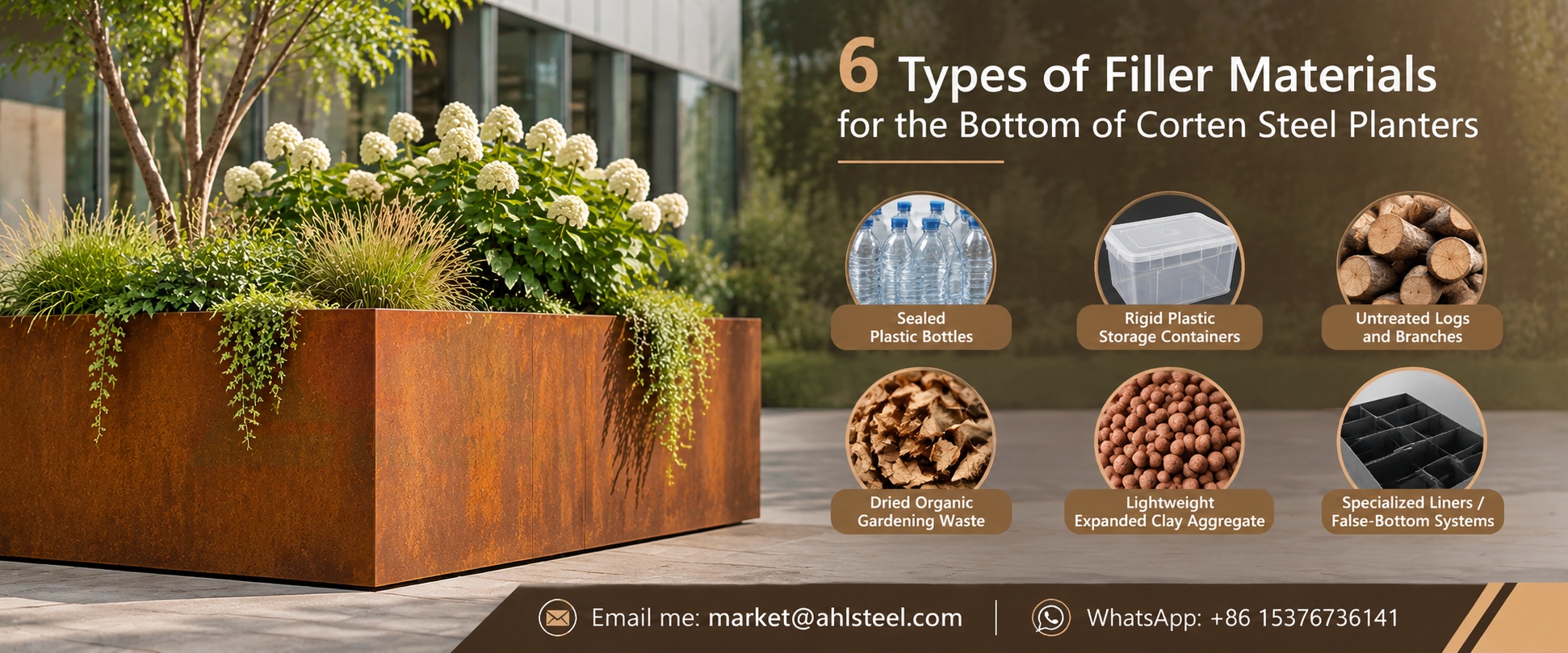
6 Types of Filler Materials for the Bottom of Corten Steel Planters
1. Sealed Plastic Bottles
Clean, tightly sealed plastic bottles are suitable for placement in the lower, non-root zone. Their light weight effectively reduces the amount of soil needed. Prioritize bottles with intact structures that are resistant to deformation, and ensure they do not block the drainage holes when placed. Suitable for home DIY gardens; however, direct use is not recommended for commercial projects, where standardized internal structures are preferred.
2. Rigid Plastic Storage Containers
Sturdy, clean plastic containers can create a stable, elevated layer beneath the planting area. They are also easier to disassemble during future repotting, soil turning, and maintenance. Be sure to choose models that are stable and resistant to collapse. Do not use scrap containers of unknown origin to avoid degradation, leakage, or drainage blockages later on.
3. Untreated Logs and Branches
Untreated logs and thick branches are suitable for naturally raised planting beds. While they can reduce the initial amount of soil required, the wood will slowly decompose and settle, requiring soil replenishment later on. The use of pressure-treated wood is strictly prohibited to prevent harmful substances from leaching into the growing medium.
4. Dried Organic Gardening Waste
Dry fallen leaves, small twigs, and suitable plant debris can be used in natural planting systems. As they slowly decompose, they also replenish organic matter. Avoid materials that rot easily, produce foul odors, or attract pests; do not compact them when filling the planting bed, as compaction hinders air circulation and drainage.
5. Inert, Porous Materials Such as Lightweight Expanded Clay Aggregate
Expanded clay aggregate is lightweight and highly porous, making it suitable for certain specialized planting systems. However, this is not a universal drainage solution; do not rely solely on a layer of expanded clay aggregate to ensure root health. The overall drainage structure and growing medium mix ratio are far more critical.
6. Specialized Lightweight Liners / False-Bottom Support Systems
Custom false bottoms and built-in support partitions offer the most controllable solution for large-scale and commercial projects. They clearly separate the elevated cavity from the root growth zone and provide the greatest stability. AHL offers standard and custom deep garden corten planters, along with corresponding design solutions for drainage, capacity, and structure. For large-scale projects, it is recommended to purchase ready-made false-bottom liners directly rather than assembling them on-site.
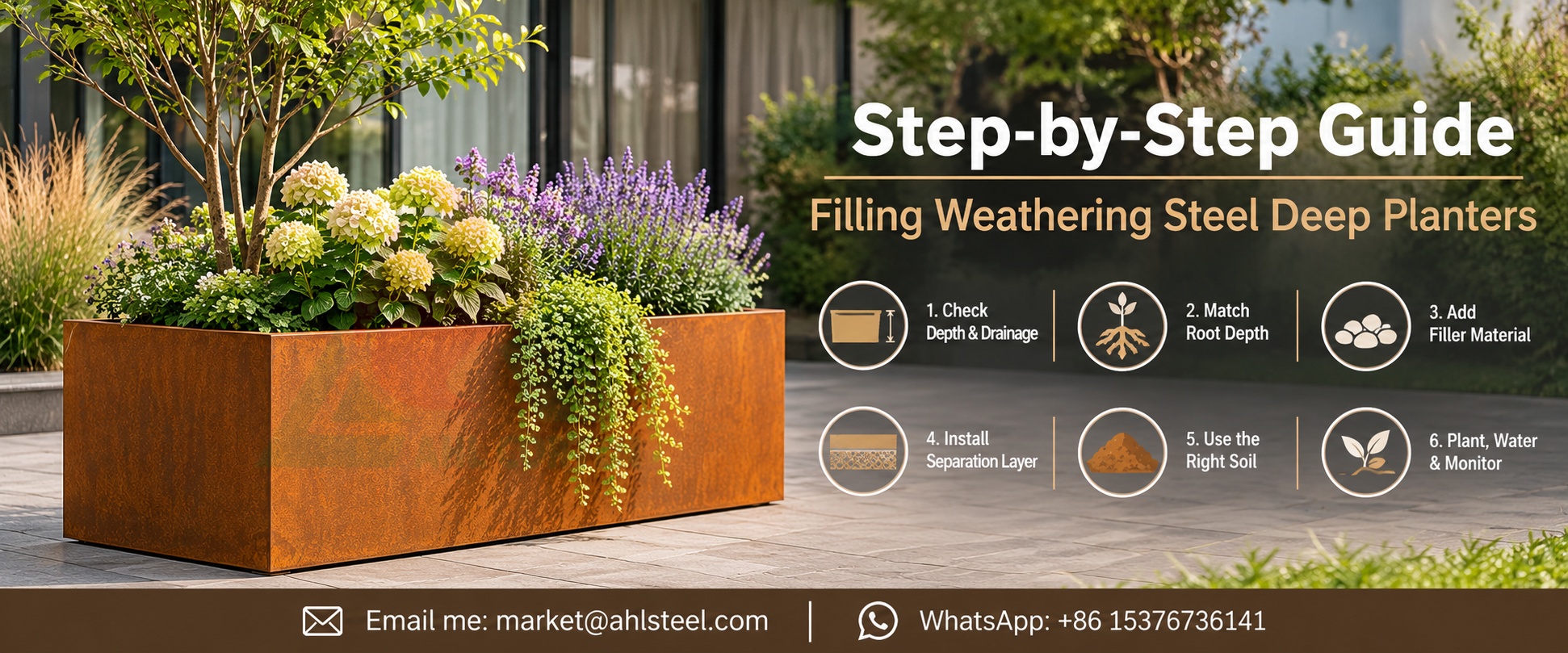
Step-by-Step Guide: Filling Weathering Steel Deep Planters
Step 1: Check the Planter’s Depth and Drainage System
Measure the internal clear height—don’t rely solely on external dimensions. Check the location of drainage holes, the bottom structure, legs, and the layout of overflow outlets. AHL recommends that outdoor metal planters have drainage holes in the bottom; before adding gravel and growing medium, lay down geotextile fabric or a protective mesh to prevent soil loss.
Step 2: Determine the Required Root Depth for Plants
The depth of the planting layer should match the mature root system requirements of the plants. Herbs, seasonal flowers, and small foliage plants require significantly less depth than shrubs and small trees. Do not reduce the root layer simply to save soil; for trees and large shrubs, sufficient depth must be ensured to guarantee long-term stability and water retention capacity.
Step 3: Add Appropriate Filler Material to the Lower Layer
If the plants do not require the full depth of the pot, fill the lower cavity with stable filler material. Place the filler material away from the drainage holes and do not compact it forcefully. The material must meet the following criteria: it should not decompose quickly, should not shift under pressure, and should not contaminate the upper planting medium. For commercial projects, prioritize the use of pre-made liners.
Step 4: Install a Separation Layer as Needed
Place a permeable separation layer between the filler material and the planting soil. Its purpose is to prevent fine soil from seeping into the coarse filler below and clogging the cavity. The goal of the separation layer is to maintain the stability of the root zone; avoid stacking multiple layers that could obstruct drainage. If root protection is required, AHL offers compatible separation liners or standalone waterproof inner containers.
Step 5: Fill with Suitable Planting Medium
Select a planting medium appropriate for the plant type, balancing aeration, water retention, and nutrient content. AHL does not recommend using native garden soil directly; instead, we suggest a lightweight, porous mixture, such as garden soil: leaf mold: perlite = 2:1:1, or a lightweight soilless medium.
Step 6: Plant, Water, and Monitor Settlement
Do not compact the soil too firmly when planting. Water thoroughly and ensure excess water drains freely. Organic fill material will settle gradually—this is normal—so top up the soil as needed; check drainage again after heavy rain to ensure it remains unobstructed.
How to Calculate the Actual Soil Volume Required for a Deep Planting Container
1. Calculate the Internal Volume of the Planting Container
Formula for the volume of a rectangular planter: Volume = Internal Length × Internal Width × Planting Depth. When units are in meters, the result is in cubic meters; 1 cubic meter = 1,000 liters. Here is an example of a large rectangular weathering steel planter: Internal dimensions: Length 120 cm, Width 60 cm, Total internal height 80 cm. Total volume when completely filled: 1.2 × 0.6 × 0.8 = 0.576 m³, approximately 576 liters. If the lower 30 cm is used for a raised fill layer and the upper 50 cm is reserved for the planting layer: 1.2 × 0.6 × 0.5 = 0.36 m³, approximately 360 liters, saving about 216 liters of potting soil. These figures are for theoretical reference only; actual soil requirements must be adjusted based on root depth, internal structure, proportion of fill material, settlement, and drainage design. A 50-cm planting layer is not suitable for all plants.
2. Prioritize Root Depth Over Pot Height When Estimating Soil Volume
First, determine the depth required for the plant’s mature root system, then define the planting layer thickness, and fill the remaining space with void-filling material. Since multiple planting pots come in different sizes, each must be calculated separately to ensure accurate ordering and control transportation and construction budgets.
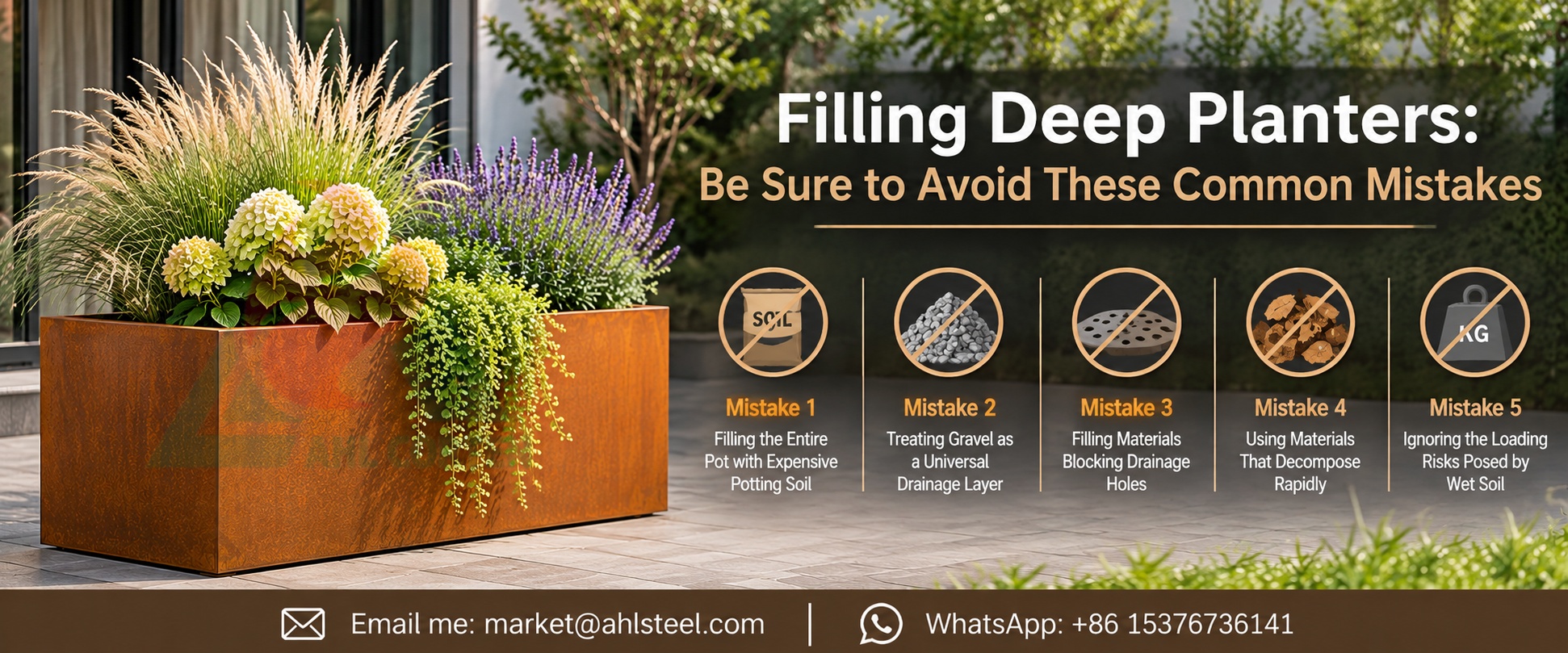
Filling Deep Planters: Be Sure to Avoid These Common Mistakes
Mistake 1: Filling the Entire Pot with Expensive Potting Soil
Don’t assume that more soil is always better. The planting layer should be just thick enough to meet the plant’s needs; use stable filler material or a false bottom liner to fill any excess space.
Mistake 2: Treating Gravel as a Universal Drainage Layer
A thick layer of gravel does not automatically improve drainage. Improper layering can raise the water table in the root zone, increasing the risk of root rot. Prioritize keeping drainage holes clear and ensuring a proper growing medium mix to establish a comprehensive drainage system. The AHL Maintenance Guide requires regular inspection and clearing of drainage holes.
No filling material should obstruct or cover the drainage holes. After filling, confirm that water can flow out smoothly. AHL recommends first laying geotextile fabric or a protective mesh at the bottom to prevent soil from washing out through the drainage holes.
Mistake 4: Using Filling Materials That Decompose Rapidly
Organic matter that decomposes very easily will settle significantly over time, causing the planting layer to sink, reducing root stability, and requiring frequent soil replenishment. Organic fillers are only suitable for scenarios where settlement is allowed and a maintenance plan is in place.
Mistake 5: Ignoring the Loading Risks Posed by Wet Soil
Wet soil is significantly heavier than dry soil. For balconies, rooftops, and patios, the total load must be calculated, including planting containers, growing media, water, plants, and accessories. AHL emphasizes that oversized weathering steel containers require special attention regarding weight limits.
Plants Suitable for Deep Corten Steel Planters (Classified by Root Depth)
1. Shallow-Rooted Plants: Suitable for Raised-Bed Filling Solutions
Lettuce, spinach, herbs, seasonal flowering plants, and small ornamental plants. AHL notes that a depth of 6–12 inches is suitable for succulents, herbs, and ornamental grasses, and is ideal for saving soil by using a raised-bed design on the lower level.
2. Medium-Rooted Plants
Sage, lavender, ornamental grasses, and medium-sized perennial flowers. Required depth varies by variety, climate, and mature plant size; confirm the plant’s root habits before planting.
3. Shrubs and Small Trees Require Ample Planting Space
Dwarf shrubs, topiary trees, and large foliage plants require a continuous, sufficiently deep root zone. Do not compromise planting space to save soil; AHL recommends a depth of at least 18 inches for these plants.
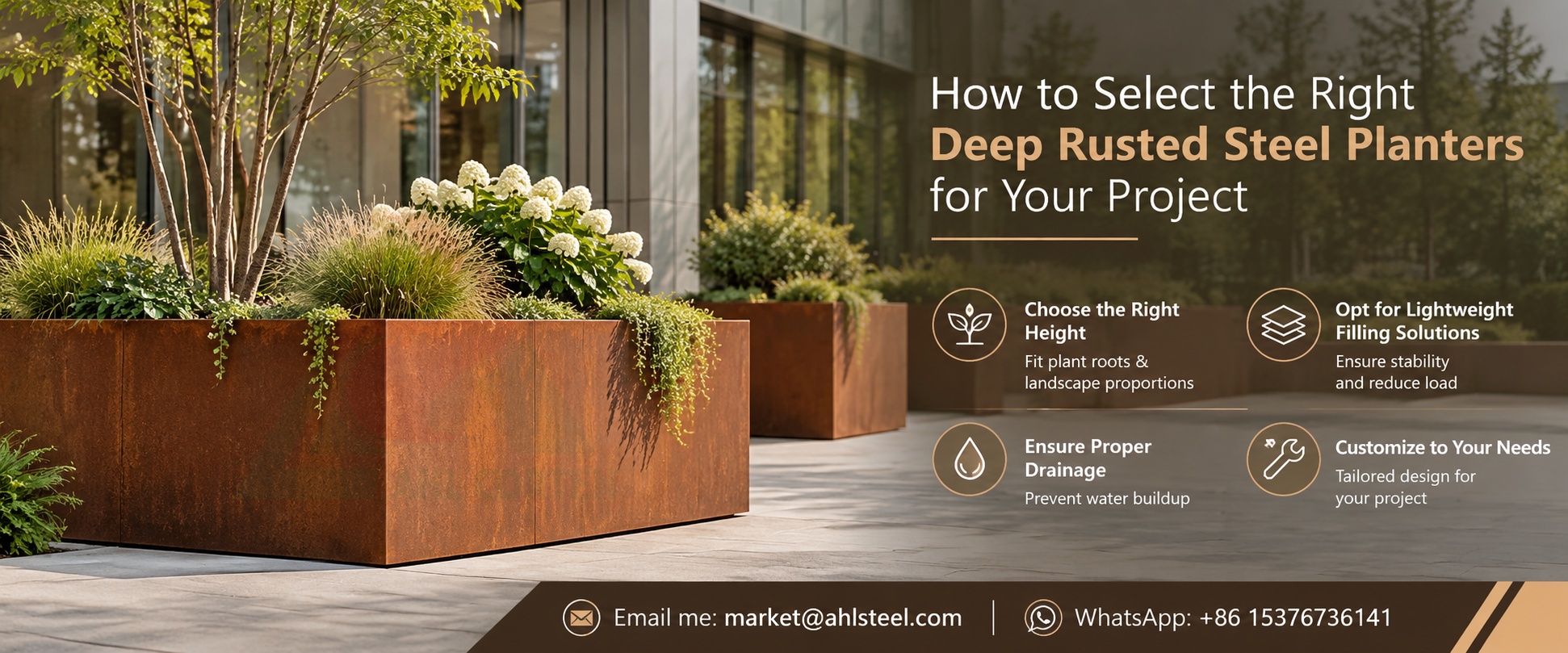
How to Select the Right Deep Rusted Steel Planters for Your Project
1. Selecting the Height Based on Plant Root Systems and Visual Proportions
Do not choose very tall planters simply for aesthetic reasons. The planter height should first meet the plant’s root system needs, then consider landscape proportions. For commercial projects, tall metal planter box dimensions should be planned in unison with paving modules, seating layouts, and planting schemes.
2. Consider Lightweight Filling Solutions and Internal Structures in Advance
When purchasing deep planters, inquire about built-in supports, false bottoms, and planting liners. These solutions reduce the amount of soil required while ensuring structural stability and proper drainage. AHL’s design solutions address key considerations regarding drainage, capacity, load-bearing capacity, and structural integrity; verify the internal construction before placing an order.
3. Verify Drainage and Installation Requirements
Confirm the number, location, and size of drainage holes, and check whether the planter includes legs or overflow outlets. AHL recommends models with legs or overflow pipes to minimize prolonged water exposure to the steel plate and improve drainage performance.
4. Customize Weathering Steel Planters to Suit Your Needs
You can customize the height, shape, drainage layout, base, and internal support structure. AHL offers both standard-sized and custom tall metal planter boxes. When placing an order, provide your planting plan, site conditions, and installation constraints, and request drawings and written confirmation of the internal structure.
For Landscape Contractors and Wholesalers: Custom Deep Corten Planters
1. Custom Sizes to Suit Various Planting Needs
We customize planter specifications based on root depth, planting plans, and installation space. AHL offers a variety of standard and custom sizes.
2. Structural Solutions for Large, Deep Planters
Large, tall corten steel planters can be equipped with optional built-in supports, false bottoms, and planting liners. This ensures structural stability and reliable drainage while reducing the amount of soil required. AHL’s design documentation covers key points regarding drainage, soil volume, dead weight, and structural calculations.
3. Custom Drainage and Base Structures
Customize drainage hole layouts, base construction, legs, and installation methods. These details directly impact plant health and the long-term performance of the planters. AHL recommends that outdoor metal planters include drainage holes and, when root isolation is required, incorporate isolation liners or separate inner containers.
4. OEM, Wholesale, and Project Supply
AHL supplies products to retailers, wholesalers, and landscaping projects, supporting custom sizes and logos. For project orders, we recommend itemized quotes: steel plate fabrication, internal structure, drainage fittings, packaging, and logistics are calculated separately.
AHL offers a variety of planter shapes—including square, round, modular, and bottomless—and supports both standard sizes and custom designs.
2. Practical Product Design
Product design balances drainage, planting capacity, root protection, weight, and structural strength to ensure long-term, stable use.
3. Wide Range of Specifications
Sheet thickness options include 1.5 mm, 2 mm, and 3 mm, with various configurations such as open-bottom and custom designs. Please confirm specific specifications before placing an order.
4. B2B Production Support
Our in-house design team supports customization of dimensions and logos. Wholesalers may request drawings, technical specifications, and packaging solutions prior to purchasing.
5. Project Customization Services
Provide planting plans, on-site photos, target dimensions, and installation constraints; AHL will then propose internal structures, drainage solutions, and a price range.
FAQ
1. What Materials Can Be Placed at the Bottom of Deep Planters to Save on Soil?
Choose stable, clean, non-root-forming fill materials, such as sealed plastic bottles, rigid storage containers, untreated lumber, or pre-made liners. The specific choice depends on root depth, drainage design, and material stability.
2. Is It Necessary to Place Gravel at the Bottom of Deep Planters?
No, it is not mandatory. A thick layer of gravel does not necessarily improve drainage and may even raise the water-logged layer. Prioritize ensuring drainage holes are unobstructed and that the growing medium mix is appropriate.
3. How Deep Should the Planting Soil Be in Large Planters?
This depends on the plant’s mature root system, water requirements, and intended lifespan. AHL Reference: 6–12 inches is suitable for succulents, herbs, and ornamental grasses; 18 inches or more is suitable for trees and shrubs.
4. Can Plastic Bottles Be Used to Fill Tall Planters?
They can be placed in the lower, root-free area. Use clean, intact bottles, ensuring they do not block the drainage holes and that the structure remains stable.
5. How Can the Overall Weight of a Deep Rusted Steel Planter Be Reduced?
Reduce the volume of fill material in non-root areas by using lightweight fillers or pre-made false bottoms, combined with lightweight growing media. Be sure to factor in the weight of wet soil and plants when calculating the total weight.
6. Are Deep Corten Steel Planters Suitable for Commercial Landscaping?
Yes, they are suitable and are widely used at hotel entrances, commercial plazas, restaurant patios, and public gardens. However, dimensions, structure, drainage, and installation plans must be determined on a case-by-case basis depending on the specific site.
Conclusion: Filling Deep Corten Steel Planters with a Scientific Approach
Tall weathering steel planters do not need to be completely filled with potting soil. By understanding the root system requirements of plants, selecting the right filling materials, and planning drainage effectively, you can reduce soil costs while creating an attractive and healthy outdoor landscape. For retailers, landscape designers, contractors, and project buyers, well-designed planter dimensions and internal structures can significantly improve installation efficiency and ensure long-term performance. AHL offers a wide range of customizable large raised planter boxes in various sizes, suitable for private gardens, commercial landscapes, and wholesale product lines. If you are looking for corten steel planter solutions, please contact AHL to discuss your needs and receive a customized quote. Want to Get Your Own Rusted Steel Planter? Click to Customize!
.jpg)


 Fill In The Inquiry