How Do I Decide What Type of Landscape Edging I Need?
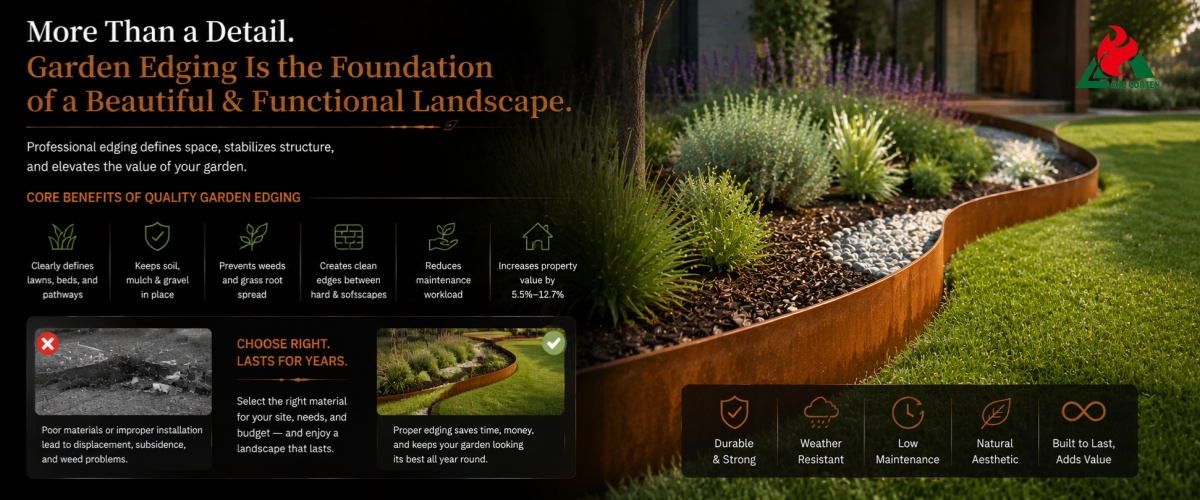
Many people regard garden edging merely as a decorative detail, yet in reality it is a core functional element of garden landscaping. High-quality garden edging can precisely demarcate landscape areas and stabilise the site structure, and is key to enhancing the quality and practicality of a garden.
Professional garden edging offers multiple core benefits: it effectively separates lawns from planting beds, secures soil, mulch and gravel, prevents the spread of weeds and grass roots, and clearly defines the boundaries between hard and soft landscaping elements such as footpaths and driveways, resulting in a clean and orderly overall landscape.
According to professional landscape research data, properly installed garden edging can reduce garden maintenance workload by 40 per cent, whilst increasing property value by 5.5 per cent to 12.7 per cent.
Conversely, edging made from unsuitable materials or installed improperly can lead to issues such as material displacement, edge subsidence and weed infestation. Not only does this require frequent rework and maintenance, resulting in higher long-term upkeep costs, but it also detracts from the garden’s overall aesthetic appeal.
Therefore, when selecting materials for garden edging, one must not focus solely on aesthetics; a comprehensive assessment must be made, taking into account functional requirements, site conditions, budget and maintenance capabilities, to create a long-lasting and durable landscape boundary.
6 Mainstream Garden Edging Materials: A Comprehensive Analysis of Pros, Cons and Suitable Applications
The mainstream garden edging materials available on the market each have their own suitable applications, service life and value for money. Only by selecting the right type based on site requirements can one achieve long-lasting and hassle-free results.
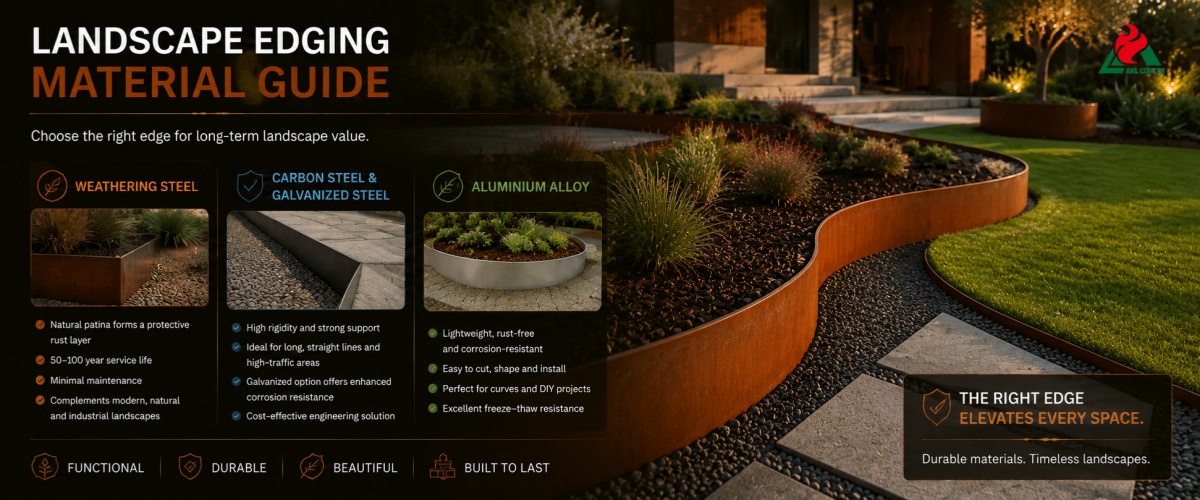
1. Weathered Steel Edging (The Premium Choice for Long-Term Durability)
Weathering steel edging is the mainstream material of choice for high-end landscape projects, and its unique properties make it suitable for a wide range of premium gardens and commercial landscape schemes.
Key Advantages: A service life of up to 50–100 years; a natural rust-resistant oxide layer forms on the surface, preventing ongoing corrosion and flaking; straight, refined lines and a sturdy structure require virtually no ongoing maintenance; it complements a variety of landscape styles, including modern, natural and industrial.
Suitable Applications: High-end private gardens, commercial landscapes, tree pit edging, raised flower beds, geometric landscape features, and gravel zoning.
Core Value: Combining functionality with aesthetic appeal, it not only provides stable zoning but also enhances the overall ambience of the garden with its vintage rust-coloured finish, creating a cohesive, high-end landscape aesthetic.
2. Standard Carbon Steel and Galvanized Steel Edging (Cost-Effective Engineering Option)
Carbon steel edging offers high rigidity and excellent support, making it suitable for long, straight boundaries and areas with high footfall and heavy loads, whilst offering outstanding value for money.
Galvanised steel undergoes a galvanising process that significantly enhances its corrosion resistance, making it suitable for damp and outdoor environments.
Points to note: Standard carbon steel is prone to rust when exposed to damp conditions over extended periods; it requires regular application of a protective coating and proper maintenance.
3. Aluminium Alloy Edging (Lightweight, Flexible – Ideal For Diy)
Aluminium alloy edging is lightweight, corrosion-resistant and rust-free. It is extremely easy to handle and install, making it ideal for DIY projects undertaken by beginners.
The material can be cut and shaped on-site to fit curved and arched designs perfectly. It also offers excellent resistance to freeze-thaw cycles, making it suitable for northern regions with significant temperature fluctuations.
Minor drawback: Their structural rigidity is inferior to that of steel, making them unsuitable for high-impact, heavy-load applications such as retaining walls on slopes.
4. Plastic or Rubber Edging (Low-Cost Temporary Solution)
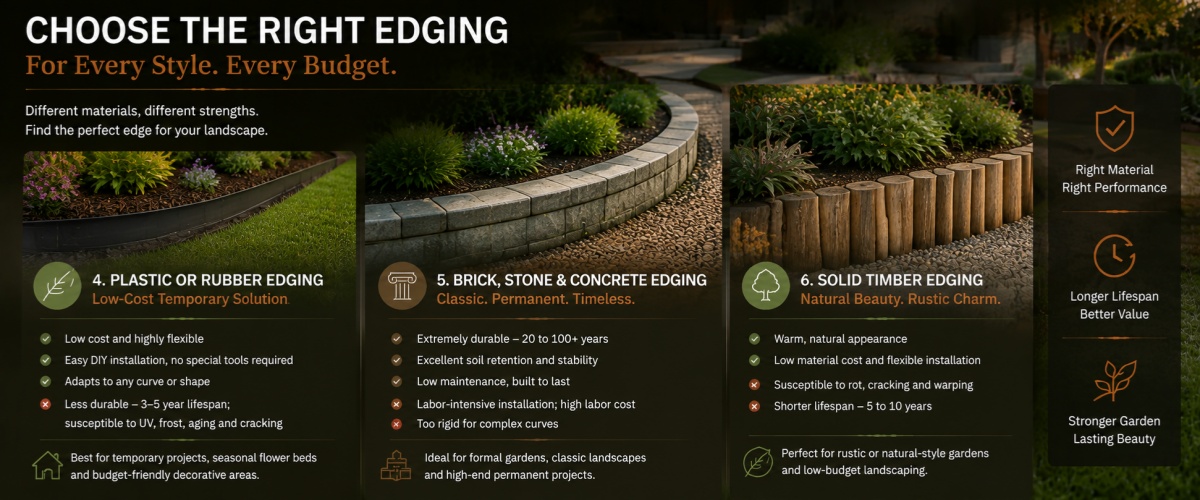
The greatest advantages of plastic and rubber edging are their low cost and exceptional flexibility, allowing them to adapt to all kinds of complex curves. Installation requires no specialist tools, making them extremely accessible for DIY projects.
Key drawback: Poor durability; standard plastic edging is susceptible to UV radiation and frost, with a service life of only 3–5 years, and is prone to ageing, brittleness, cracking, displacement and loosening.
Suitable applications: Temporary garden renovations, annual flower bed rotations and purely decorative areas on a tight budget; not recommended for professional landscaping or long-term, permanent installations.
5. Red Brick, Stone and Concrete Edging (Classic, Permanent Designs)
All three materials are traditional, permanent edging materials with a service life of 20–100 years. They possess a substantial, dignified and grand texture, and are well-suited to formal European and traditional Chinese gardens.
Key advantages: Exceptional ability to stabilise soil and retain materials; high stability; requires virtually no frequent maintenance.
Key drawbacks: Installation is labour-intensive, requiring precise excavation of foundation pits and levelling of the sub-base, resulting in high labour costs; the material is too rigid to accommodate complex curves or irregular shapes.
6. Solid Timber Edging (Exclusive to Rustic and Natural Styles)
Solid timber edging has a warm, natural texture, making it suitable for pastoral and rustic-style gardens. It offers low material costs and flexible installation.
Significant drawbacks: Prolonged exposure to soil and moisture can lead to rot, cracking and warping; the typical service life is only 5–10 years, with faster deterioration in damp and rainy regions.
Suitable for: Temporary natural-style landscaping and low-budget leisure gardens; not suitable for long-term, permanent landscaping projects.
Selecting Edging Based on Garden Design: Solutions for Straight, Curved and Irregular Shapes
The overall lines and shapes of the garden directly determine the suitability of the edging material. Selecting materials to match the design ensures both a smooth installation and the best visual effect.
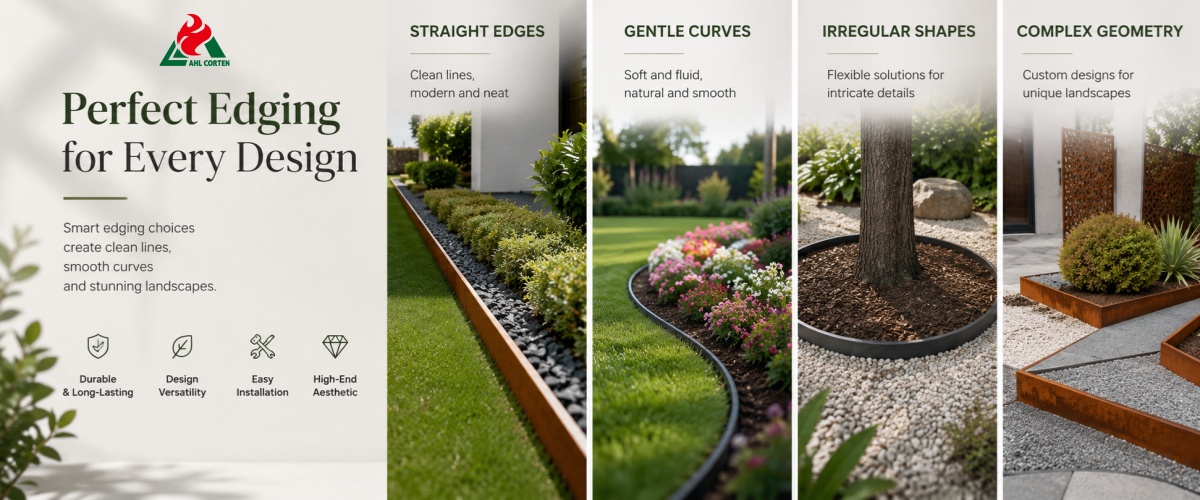
1. Straight Edges: Clean and Neat, Suitable for Rigid Materials
Straight garden edges require a flat, straight and clean line. Rigid materials such as weathering steel, galvanised steel, red brick and concrete are the preferred choice, creating a minimalist, sophisticated modern aesthetic.
2. Gentle, Broad Curves: Soft and Fluid, Suitable for Flexible Materials
Gentle curves in flowerbeds and arched boundaries along footpaths are best suited to flexible, bendable materials.
Aluminium alloy, thin-gauge steel, plastic and rubber edging are the preferred choices; their lines are natural and smooth, facilitating mower operation whilst offering a visually pleasing, unobtrusive appearance.
3. Sharp Bends and Circular Tree Pits: Intricate Irregular Shapes, Customised Solutions
For sharp bends such as tree borders and small circular flower beds, it is not advisable to forcefully bend thick, rigid materials, as this can lead to deformation, cracking and uneven joints.
Flexible plastic and rubber edging are the preferred choices; for a high-end finish, customized segmented weathering steel edging can be selected to precisely match irregular curves.
4. Complex Geometric Shapes: Customised, High-End Materials
Geometric patterns in gardens, distinctive landscape features and irregularly shaped landscape elements at commercial entrances demand the highest standards of precision and aesthetic appeal.
Laser-cut, customised weathering steel and segmented stone combinations are the preferred choices, enabling the precise realisation of various design schemes to create unique landscape highlights.
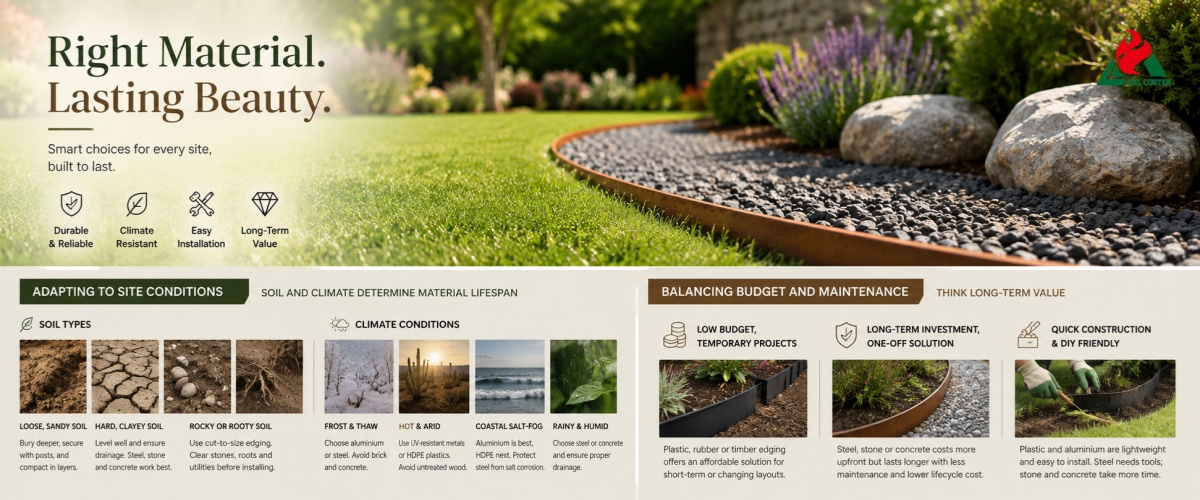
Adapting to Site Conditions: Soil and Climate Determine Material Lifespan
The service life of the same edging material can vary significantly depending on the soil and climate conditions. Selecting materials suited to the site environment is essential to avoid frequent damage and the need for rework later on.
1. Key Considerations for Material Selection and Installation in Different Soil Types
Loose, sandy soil: As the soil is loose and prone to subsidence, edging must be buried deeper and secured with additional fixing posts. After backfilling, the soil must be compacted in layers to prevent the material from shifting or subsiding.
Hard, clayey soil: Excavation is difficult, but there is no need to replace the material frequently. The focus should be on levelling the excavation pit and ensuring proper drainage; rigid materials such as steel, stone and concrete are preferred.
Soil with many stones and roots: Prioritise edging made of cut-to-size metal or plastic. Clear stones, roots and underground utilities before construction to avoid obstacles.
2. Guidelines for Material Selection in Different Climates
Regions with severe frost and thaw cycles: Prioritise aluminium alloy and steel, which offer excellent resistance to frost heave and displacement; avoid unreinforced red bricks and concrete to prevent cracking and warping caused by freeze-thaw cycles.
Hot and arid regions: Select metals and high-density plastics resistant to UV ageing; avoid ordinary plastics and untreated timber to prevent brittle fracture due to high temperatures and rapid decay.
Coastal salt-fog regions: Aluminium alloy offers the best resistance to salt corrosion, followed by HDPE plastic; weathering steel requires protective treatment to delay salt-fog erosion.
Rainy and humid regions: Steel and concrete are best suited; drainage gaps must be provided to prevent waterlogging, which can cause material damage and root rot due to water accumulation in the soil.
Balancing Budget and Maintenance: Initial Cost Versus Long-Term Value
When selecting materials for garden edging, do not focus solely on low prices; instead, consider the initial cost, service life and maintenance costs comprehensively to calculate the overall long-term value for money.
1. Low Budget, Temporary Renovations: Prioritize Low-Cost Materials
For short-term garden renovations or flowerbeds where the layout is frequently changed, plastic, rubber or natural timber edging can be used. These require a low initial investment and are sufficient to meet basic decorative and zoning requirements.
2. Long-Term Investment, a One-Off Solution: Prioritise Durable Materials
For long-lasting, hassle-free results and reduced long-term maintenance costs, opt for weathering steel, standard steel, stone or concrete. Although the initial cost is higher, these materials do not require frequent replacement, repair or repainting, resulting in the lowest overall life-cycle cost.
3. Rapid Construction and DIY Implementation: Prioritise Lightweight Materials
For quick completion and DIY installation, plastic and aluminium alloy edging are the top choices, as they are lightweight, easy to cut and simple to install. Steel installation requires specialised tools, whilst stone and concrete involve the longest construction periods and the most complex processes.
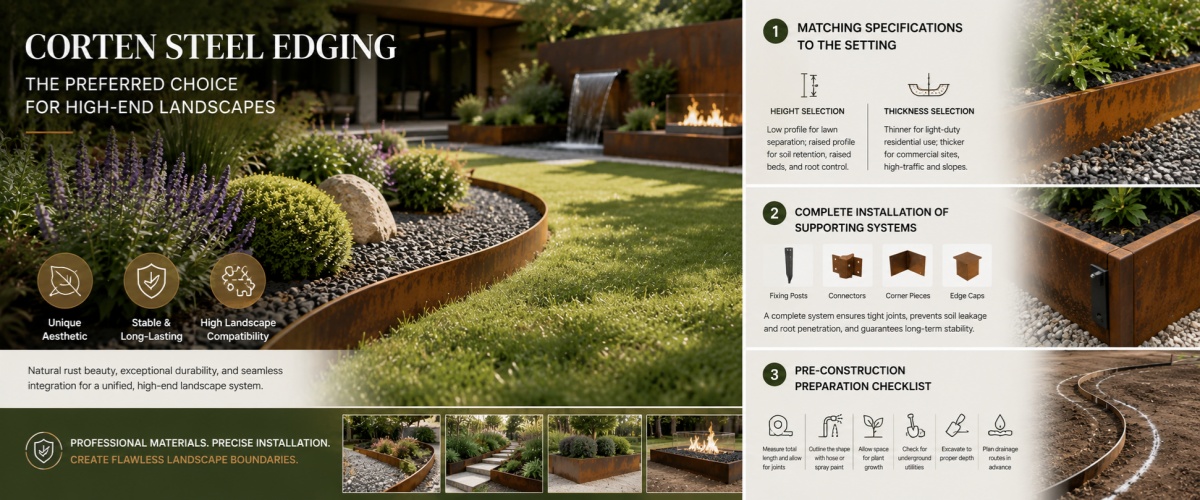
Corten Steel Edging: The Preferred Choice for High-End Landscapes
In high-end private gardens and commercial landscaping projects, weathering steel edging has become the mainstream choice thanks to its dual advantages of aesthetic appeal and performance, making it suitable for all types of high-quality landscape design.
Unique Aesthetics and Texture: The natural, vintage rust colour contrasts strikingly with greenery, offering a sophisticated texture that complements modern, minimalist and natural-style gardens perfectly.
Stable and Long-Lasting Performance: With an exceptionally long service life, it withstands wind pressure and impact from tools, as well as extreme temperatures, requiring virtually no routine maintenance.
High landscape compatibility: It can be combined with complementary products such as weathering steel planters, feature walls, water features and fire features to form a unified garden landscape system, creating a highly cohesive overall design.
Professional Material Selection and Installation Techniques: Creating Fault-Free Landscape Boundaries
1. Matching Specifications to the Setting
Height Selection: Choose a low-profile option for lawn partitioning; opt for a raised profile for soil stabilization and raised flowerbeds to meet requirements for debris retention and root containment.
Thickness Selection: Opt for thinner profiles in light-duty domestic settings, whilst thicker profiles are recommended for commercial sites, high-footfall areas and sloped retaining applications to enhance structural stability.
2. Complete Installation of Supporting Systems
High-quality edging requires the use of specialised fixing posts, connectors, corner pieces and edge caps to prevent loose joints, soil leakage through gaps and grass root penetration, thereby ensuring overall密封性 and stability.
3. Pre-Construction Preparation Checklist
Accurately measure the total length of the site, allowing for joints and corners; use a hose or spray paint to outline a smooth shape; allow space for plant growth; check for underground utilities; excavate the foundation pit to the standard depth and plan drainage routes in advance.
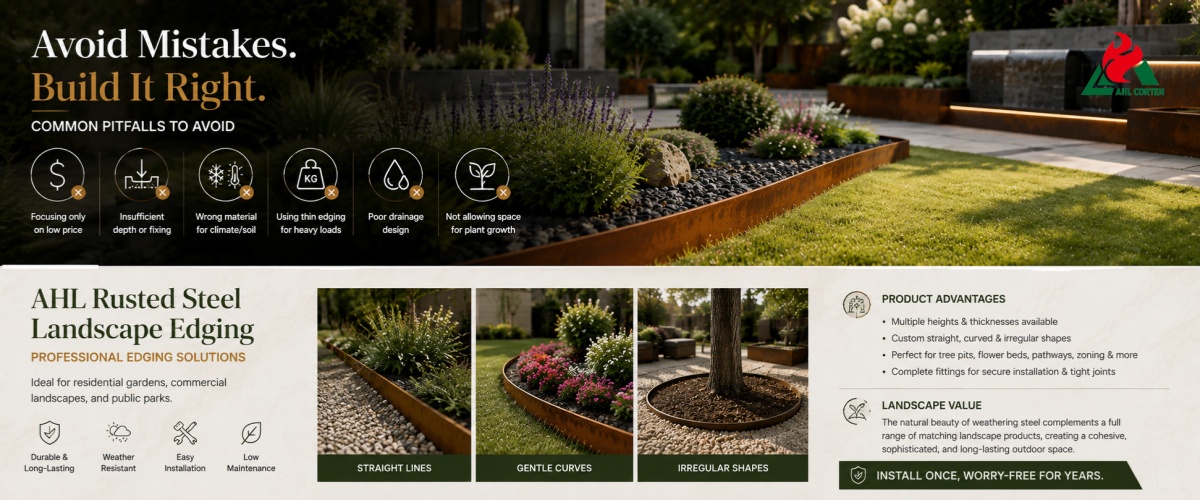
Common Material Selection and Construction Pitfalls: Avoid Them in Advance to Minimize Rework
Many problems with garden edging that arise later on are not due to material quality, but rather to errors in material selection and construction, which must be avoided in advance:
1. Focusing solely on unit price rather than lifespan; low-cost materials require frequent replacement, resulting in higher long-term costs;
2. Insufficient burial depth or inadequate fixing, leading to grass root intrusion, material displacement and subsidence;
3. Materials unsuitable for the climate or soil—such as using standard plastic in cold conditions or untreated timber in damp areas—accelerate deterioration;
4. Using thin, decorative edging to bear earth pressure or structural loads, leading to structural deformation and failure;
5. Neglecting drainage design, where waterlogging causes soil softening and loosening of the edging;
6. Failing to allow space for plant growth, which restricts plant development and disrupts the boundary’s shape.
AHL Rusted Steel Landscape Edging: Professional Landscape Edging Solutions
AHL weathering steel edging is suitable for a wide range of settings, including residential gardens, commercial landscapes and public parks, offering a one-stop, bespoke edging solution.
Product Advantages: Available in a range of heights and thicknesses, with customisation options for straight, curved and irregular shapes, suitable for tree pits, flower beds, footpaths, zoning and other applications; comes with a full set of specialised fittings for secure installation and tight joints.
Landscape Value: Leveraging the natural texture of weathering steel, it can be paired with the full range of landscape products in the same style to create a cohesive, sophisticated and long-lasting garden landscape, truly delivering ‘install once, worry-free for years’.
Frequently Asked Questions (FAQ) about Corten Steel Edging
Q1: What Is The Most Durable Landscaping Edging Material?
Weathering steel, stone and high-quality concrete offer the best durability, with a service life spanning decades or even a century; however, the ultimate durability depends on construction techniques, local climate and routine maintenance.
Q2: Can Weathering Steel Edging Be Shaped Into Curves?
Yes. Gentle curves can be fine-tuned on-site to fit the terrain, whilst sharp bends and circular shapes can be achieved through customised sections and pre-fabricated curves, resulting in a smooth and refined finish.
Q3: What Edging Materials Are Suitable For Small Gardens?
Choices depend on your budget: for value for money, opt for aluminium alloy or high-quality plastic; for texture and long-term durability, thin-gauge weathering steel edging is the preferred choice.
Q4: Which Edging Can Completely Prevent Grass Roots From Spreading?
Metal edging buried to the correct depth with continuously sealed joints provides the best results. When combined with standard installation practices, it can prevent grass root intrusion at the source.
Q5: Will Weathering Steel Edging Stain The Ground?
During the initial oxidation phase, a small amount of rusty water may seep out; this can be mitigated by laying a gravel buffer zone and optimising drainage pathways. Once the oxidation layer has stabilised, there will be no contamination issues.
Q6: Does Landscaping Edging Require Professional Installation?
Simple, low-profile decorative edging can be installed as a DIY project; however, for retaining walls, high-load applications, irregular shapes, or commercial settings, it is recommended that a professional team carry out the work to ensure stability and aesthetic appeal.
Conclusion: Choose Materials According to Your Needs to Create Long-Lasting, Refined Garden Edging
The key to high-quality garden edging is to prioritise functionality over aesthetics, selecting the appropriate type based on the site’s function, design, soil and climate conditions, as well as budget and maintenance requirements.
For minimalist, modern and long-lasting gardens, weathering steel edging is the first choice; for DIY flexible curved designs, aluminium alloy or plastic are preferable; for traditional, dignified landscapes, stone, red brick and concrete are suitable; whilst for natural, temporary landscaping, untreated timber may be used.
If you wish to say goodbye to frequent maintenance, refurbishment and reworking, whilst enhancing the aesthetic appeal of your garden and the value of your property, AHL weathering steel garden edging offers a long-lasting solution that combines design, stability and value for money, creating clean, neat and enduringly attractive landscape boundaries for your garden.
Get a Quote
Back

 Fill In The Inquiry