
Focus On The Latest News
Home > News
Corten Steel Water Feature Plate Thickness: How to Prevent Bending
Date:2026.10.13
Share to:
A corten steel water feature can bend when a long, unsupported plate carries water weight, experiences hydrostatic pressure, heats and cools unevenly, or is moved without adequate lifting support.

Choosing thicker steel helps, but plate thickness alone cannot solve poor span design, missing stiffeners, weak support frames or inadequate drainage.
This article explains how to select a suitable plate thickness and combine it with bracing, folded edges, support frames, drainage and correct installation. The goal is not to specify one universal thickness, but to help buyers ask for the right technical details before fabrication.

Want the Latest Catalog for Corten Steel Water Features? Contact Us!


Quick Answer: How Do You Prevent Bending?


Design Factor What to Specify Why It Prevents Bending
Plate Thickness Select thickness based on span, water depth, and overall feature size. Thicker plate improves rigidity and provides greater resistance to deflection.
Unsupported Span Limit long, flat, unsupported sheet areas. Wide, unsupported faces are more likely to bow under water pressure and handling loads.
Folded Returns Add folded top edges, return folds, or formed perimeter profiles. Creates a stiffer profile without relying only on thicker steel plate.
Internal Stiffeners Add internal ribs, support frames, or cross-bracing. Supports large troughs and long water walls by controlling panel movement.
Base Support Use a level, continuous, and stable foundation. Prevents twisting, point loading, uneven settlement, and distortion of the water feature.
Water Depth Confirm the maximum operating water level and overflow height. Water pressure increases with depth, increasing the load applied to side walls and panels.
Lifting Details Specify lifting points, lifting orientation, and the handling method. Prevents distortion caused by incorrect lifting, transport, or installation handling.
Drainage Include drain points, service drains, and controlled overflow routes. Avoids standing water, freeze-related damage, unintended overload, and long-term deformation risks.


Direct answer: For small decorative elements, 3–4 mm may be adequate when the span is short and the structure is well supported.

Larger troughs, water walls and public installations often need 5–8 mm plate plus folded edges, internal stiffeners or a structural frame.

Final thickness should be confirmed from approved drawings, water depth, span, steel grade, support conditions and site loads—not selected by product size alone.


Want the Latest Catalog of Metal Water Features? Contact Us! 


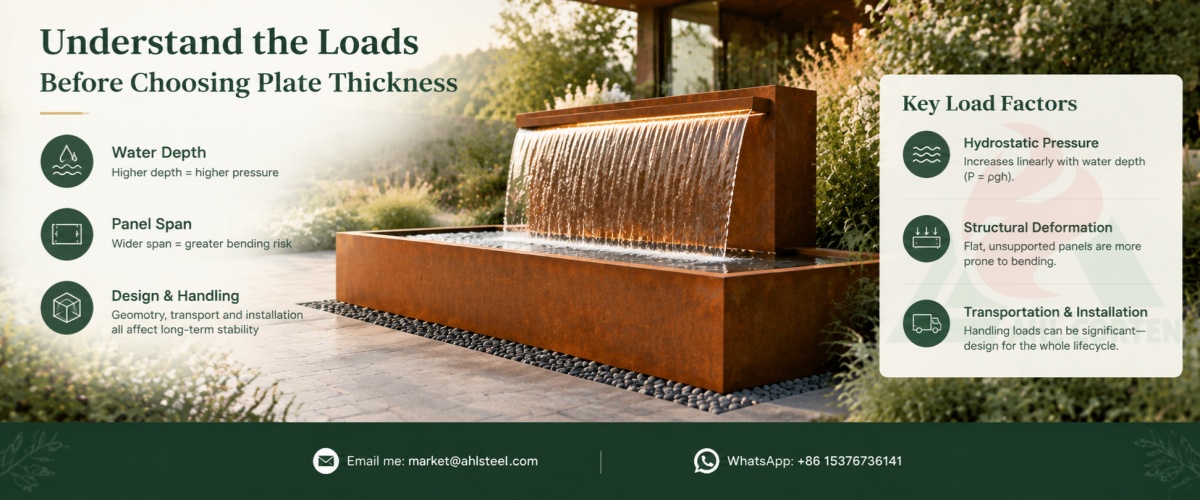
Understand the Loads Before Choosing Plate Thickness


When selecting sheet thickness for a
rusted steel water feature, it is essential to first understand the loads it will bear, rather than simply choosing sheets that appear thicker.

Water depth, panel span, the structure’s geometry, transportation methods, and installation conditions all affect whether the finished structure can remain straight, stable, and leak-free over the long term.

Hydrostatic pressure increases linearly with water depth, while flat, unsupported steel panels are more prone to deformation (deflection) as the span increases.


1. Water Weight and Hydrostatic Pressure


Water is heavy: one cubic meter of water weighs approximately 1,000 kilograms. In
corten waterfall fountain installations, this weight exerts hydrostatic pressure on the bottom and the lower sections of the side walls.

Pressure increases linearly with depth, following the formula P = ρgh; therefore, when the water depth doubles, the pressure at the bottom also doubles.
Deeper tanks increase the pressure on the side walls (especially near the bottom).
Longer tanks increase the risk of significant bending deformation in the wide, flat front panels.
Wide pools may require both thicker panels and a bottom frame or support structure.
The bottom must support the full weight of the water, as well as the weight of the steel structure itself, the pump equipment, decorative stone, and any surrounding finishes.
For example, water 600 millimeters deep exerts approximately twice the hydrostatic pressure on the bottom compared to water 300 millimeters deep. Although shallow water feature installations may appear to carry light loads, their large surface area can still result in a substantial total weight.


2. Effects of Span and Shape


Long, flat front panels are more prone to deformation than components with flanges, curves, or frames. Panel thickness is only part of the solution: designs such as flanges, rolled edges, box-shaped cross-sections, internal stiffeners, and intermediate supports can significantly increase rigidity and reduce noticeable bending deformation.

Without intermediate support, even shallow, long basins may experience bending deformation.
Flanges, rolled edges, and box-section designs enhance the stiffness of the panel edges.
Curved shapes, such as bowls or cylinders, often exhibit greater stiffness than wide, flat panels because their geometry distributes the load differently. The use of internal supports or concealed framing elements maintains a clean appearance while effectively controlling deformation.
When setting actual specifications, panel thickness cannot be determined based solely on water depth. Suppliers must comprehensively consider water depth, unsupported span, edge construction, weld location, and any internal or external support structures.


3. Transportation and Installation Loads


Before
corten outdoor water feature installations arrive at their final installation sites, they may undergo processes such as hoisting, flipping, stacking, forklift unloading, or crane handling. These temporary handling loads may differ significantly from the water loads encountered during normal operation.
Large water feature installations require clearly marked lifting points and detailed handling instructions.
Forklift slots, lifting eyes, or lifting attachment points (lifting points) should be provided as appropriate.
Even if the water feature basin is structurally sound, structural deformation may still occur if the lifting point is located on an unsupported edge or if the forklift tines are spaced too closely together.

Long, rectangular basins should be supported at multiple points during transport to minimize sagging and twisting.
The installation team is strictly prohibited from dragging the water feature across paved surfaces or lifting it by grasping only the thin edges, overflow edges, or decorative edges.

Therefore, the final panel thickness and reinforcement design must account for the product’s entire lifecycle, including manufacturing, packaging, transportation, lifting, installation, filling with water, and long-term outdoor use.


Want a Free Quote on Corten Steel Water Fountain? Contact us! 


Use a Practical Thickness and Reinforcement Matrix


Application Typical Design Approach Key Anti-Binding Details
Small Wall-Mounted Water Blade 3–4mm visible face with supporting backing. Short projection, folded return, and rigid rear support.
Compact Garden Trough 4–5mm shell, depending on span and water depth. Folded rim, stable base support, drain point, and overflow provision.
Medium Courtyard Water Feature 5–6mm shell with an internal frame or reinforcing ribs. Intermediate stiffeners, welded corners, and accessible pump-service points.
Long Linear Troughs or Water Tables 6–8mm shell combined with structural support. Cross-bracing, a continuous level base, and modular fabrication where required.
Public or High-Use Installation Project-specific engineering review and structural design. Heavy plate, welded support frame, anchor points, service access, and a defined lifting plan.


These are preliminary planning ranges, not a substitute for structural design. The required specification changes with dimensions, steel grade, water depth, exposure, support spacing, handling method and local project requirements. Industry guidance commonly notes that long basins require stiffeners, folded edges or internal support, while larger structural shells may require 5–8 mm plate or more.


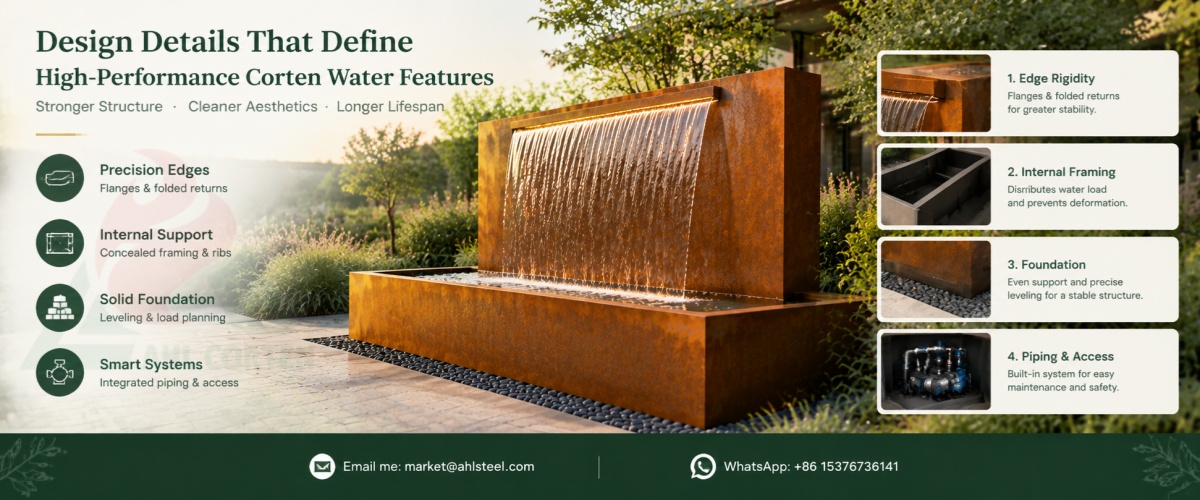
Design Details That Define High-Performance Corten Water Features


While steel thickness is foundational, precision edge detailing, concealed structural framing, base support, and pre-planned maintenance access dictate whether a
 corten steel rain curtain maintains its structural integrity and flawless aesthetic over time.


1. Edge Rigidity: Flanges & Folded Returns


Simply increasing the overall steel gauge adds unnecessary weight and material cost. Integrating strategic folds and top flanges delivers superior effective stiffness to long, unsupported steel panels.

Mitigating Panel Deflection: Inward-folded returns and double-box top rims disrupt continuous panel spans, eliminating the "tank effect" (wave-like thermal warping and hydrostatic bulging) across wide water faces.

Flow Coordination: Precision-engineered top lips ensure flat, uniform water overflow along water walls and spillways without creating unwanted turbulence or spray.

Safety & Handling: Smooth, radiused return edges protect site personnel during installation and create a substantial architectural shadow-line.


2. Concealed Internal Framing & Structural Ribs


Freestanding water walls, long troughs, and deep basins require internal reinforcement to distribute static water weight and dynamic transport loads.

Internal Stiffener Ribs: Vertical channel stiffeners welded inside the water chamber divide long, flat spans into rigid, high-strength sub-sections without altering the clean, exterior corten face.

Base Cross-Bracing: Lower structural cross-ties support the central base plates, preventing floor sag and protecting sub-surface plumbing fittings.

Rigid Skeleton Frames: Large-scale commercial basins leverage integrated internal box-section frames to absorb hoisting, rigging, and crane stresses during site installation.


3. Foundation Engineering & Leveling Accuracy


A corten water feature must be engineered for its total operational load—including water weight (1,000kg/m^3), steel shell, internal stone, and pump equipment.

Full-Surface Base Support: Weight should be distributed uniformly across concrete footings or reinforced paving systems rather than point-loaded on isolated shims.

Precision Leveling: Water surfaces act as natural spirit levels. Even a 2mm foundation tilt creates an uneven waterline, causing dry patches on water walls or localized overflow spills.

Load Calculation Standard: Structural slabs for large commercial features should be certified by a civil or structural engineer to accommodate long-term soil settlement and dynamic water volume.


4. Integrated Piping & Maintenance Access


Retrofitting pumps, valves, and electrical conduits after fabrication compromises structural integrity, damages protective coatings, and creates hard-to-seal leak risks.

Concealed Maintenance Pit: Position pumps, filters, and valves inside dedicated, ventilated equipment chambers or removable panels for hassle-free servicing without disturbing surrounding hardscaping.

Controlled Drainage & Overflow: Incorporate dedicated low-point drain valves and hidden overflow ports to direct excess rainwater safely into storm drains rather than eroding surrounding paving.

Factory Pipe Penetrations: All inlet, outlet, and electrical pass-throughs should be laser-cut and fully seam-welded during factory fabrication to ensure 100% watertight integrity.

Corten steel water fountain

 
Want to Get Your Own Rusty Metal Water Feature? Click to Customize! 


Corten-Specific Water Management


Weathering steel performs best in environments where the surface alternates between wet and dry conditions. If the design involves water retention, exposed weathering steel should not be left submerged in water for extended periods unless the relevant surfaces have been protected by appropriate lining, coating, or a separate liner.

For water retention areas, specify the use of liners, sealed liners, or compatible lining components.
Avoid exposing unprotected steel edges to prolonged standing water, soil, or accumulated debris.
Design an effective drainage system, ensure that drainage outlets are easily maintainable, and provide overflow channels.
In cold climates, design a thorough drainage plan to minimize damage caused by freezing.
For initial rust water runoff, use gravel strips, dark-colored stones, drainage ditches, or other suitable landscape features.

The Weathering Steel Application Guide explicitly states that prolonged standing water on unprotected surfaces should be avoided; design guidelines for
corten waterfall fountains also recommend specifying requirements for drainage, linings, and controlled drying (to ensure the surface dries in a timely manner).

Corten steel water fountain

 
Want to Create a Unique Corten Steel Waterfall? Contact Us!


Questions to Ask Before Ordering


Question Why It Matters
What is the maximum water depth? Determines water pressure and basin load.
What is the longest unsupported span? Helps determine the need for reinforcing ribs or a support frame.
What steel thickness and grade is proposed? Confirms structural and fabrication requirements.
Are folded edges, ribs, or a hidden frame included? Prevents relying on plate thickness alone to resist deformation.
Is the water-holding area lined or coated? Helps protect the water feature from prolonged water contact and leakage.
How will overflow and drainage work? Prevents unintended flooding, trapped water, and rust staining.
What foundation is required? Ensures adequate support and level installation.
How will the unit be lifted and delivered? Reduces the risk of transport damage and installation-related deformation.
Can the supplier provide fabrication drawings? Allows the design, reinforcement, and dimensions to be reviewed before production.


FAQ


1. What Thickness of Corten Steel Prevents a Water Feature from Bending?


There is no single thickness for every project. Small supported elements may use 3–4 mm plate, while large troughs or public water features often require 5–8 mm plate with stiffeners, folded edges or a structural frame.


2. Can Thicker Corten Steel Replace Internal Reinforcement?

Not always. Long or wide flat panels may still deflect even when made from thicker plate. Internal ribs, edge returns and base support are often more effective and economical.


3. Can Bare Corten Steel Hold Water Permanently?

It should not be assumed to do so. Water-retaining zones generally require a suitable liner, coating or separate insert, while drainage should prevent water from sitting against unprotected steel.


4. Why Does a Water-Feature Panel Bend After Installation?

Possible causes include insufficient plate thickness, long unsupported spans, missing stiffeners, excessive water depth, uneven foundations, incorrect lifting or freeze damage.

Need a Corten Water Feature That Stays Straight?


Send AHL your dimensions, water depth, drawings and installation details. Our team can recommend a suitable shell thickness, reinforcement layout, drainage solution and custom finish for your garden, hotel or landscape project.

Want to Create a Unique Corten Steel Waterfall? Contact Us!

 
Back
Next:
Back to list
Fill In The Inquiry
After receiving your enquiry, our customer service staff will contact you within 24 hours for detailed communication!
* Name:
*Email:
* Telephone/Whatsapp:
Country:
* Inquiry: