Corten Steel Screens: 2mm vs. 3mm Thickness Compared
When selecting corten steel fencing for gardens, patios, or commercial landscapes, panel thickness is the primary parameter to consider during procurement. For two fencing panels that are identical in appearance and dimensions, choosing between 2mm and 3mm will directly affect the panel’s weight, rigidity, ease of fabrication, and the project’s total cost.
Many customers have two questions: Is a 2mm Corten privacy fence suitable for outdoor use? And if upgraded to 3mm, is a supporting frame no longer required?
The answer cannot be determined by thickness alone. Under identical conditions, 3mm panels offer greater rigidity and are less prone to bending; however, the panel dimensions, laser-cut patterns, unsupported span, and installation structure all determine the final performance.
Given the same material, dimensions, and cutout layout, 3mm panels require approximately 50% more material than 2mm panels, and the panel weight increases accordingly; however, the cost of the entire screen system does not rise by 50%.
Understanding the differences between the two is essential for selecting the appropriate thickness for rusted screens and avoiding unnecessary waste in material and installation costs.

Quick Comparison: 2mm vs. 3mm Corten Steel Screens
| Comparison Factor |
2 mm Corten Steel Screen |
3 mm Corten Steel Screen |
| Core Advantage |
Lighter panel weight |
Better panel rigidity and greater resistance to bending |
| Panel Weight |
Lightweight |
Approximately 50% heavier than the equivalent 2 mm specification |
| Suitable Applications |
Decorative panels with a supporting frame |
Projects requiring higher rigidity |
| Frame Requirements |
Usually requires a frame or reinforcement |
May still require a frame or reinforcement components |
| Laser-Cut Openings |
Fine connecting ribs require careful structural evaluation |
Cutout details also require process review |
| Installation Characteristics |
Relatively easy handling and lifting |
Requires special consideration of loads caused by panel weight |
| Material Consumption |
Uses less material |
Uses more material |
| Purchasing Approach |
Evaluate panel dimensions together with the supporting structure |
Evaluate the complete panel-and-support system as a whole |
Note: This table is intended solely as a purchasing reference and does not constitute engineering specifications. Actual performance depends on the steel grade, panel dimensions, cutout patterns, support method, and on-site conditions.
No single thickness is universally suitable for all scenarios. A well-designed, supported 2mm panel can easily meet stability requirements; however, a large, unsupported 3mm panel installed outdoors in a wind-exposed location will still require additional reinforcement.
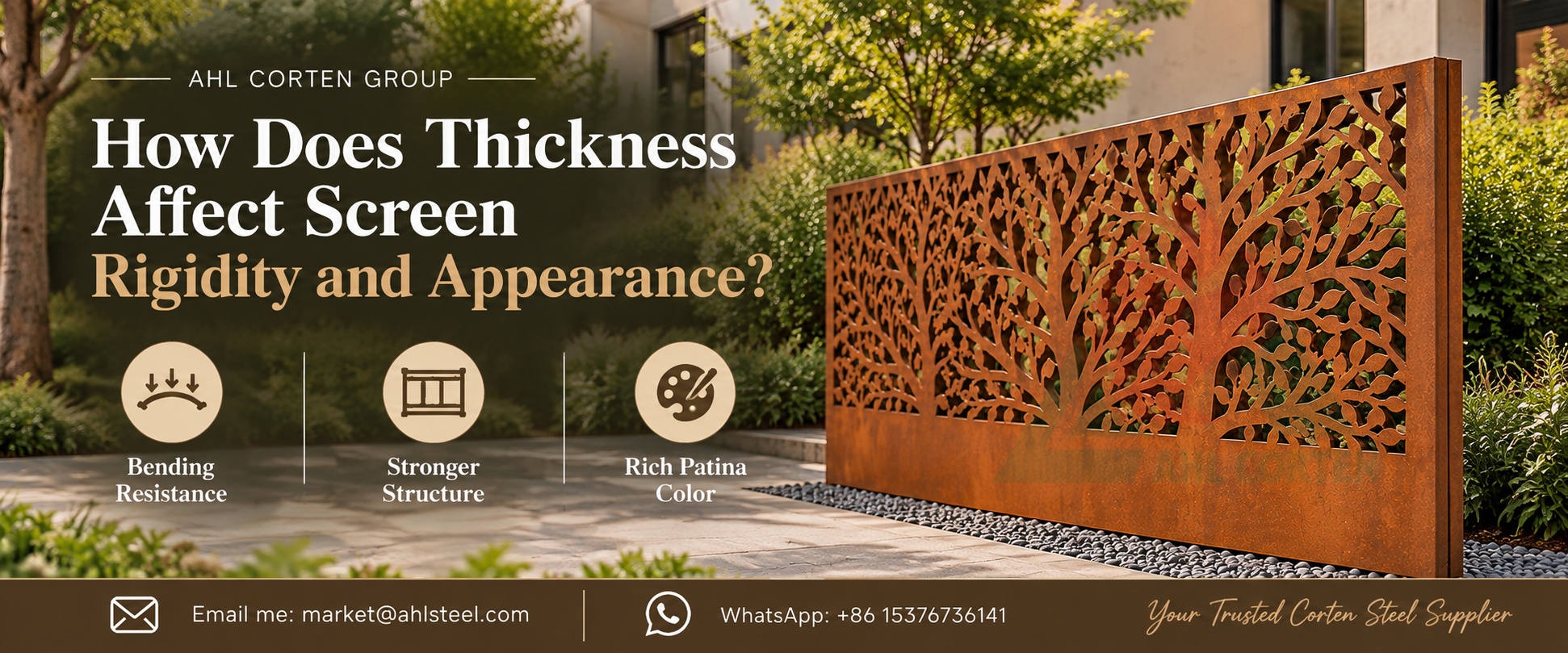
How Does Thickness Affect Screen Rigidity and Appearance?
1. Resistance to Bending Is Not the Same as Steel Grade
Sheet thickness and steel grade are two independent parameters. Thickness refers to the physical thickness of the steel sheet, while grade refers to the steel’s chemical composition and mechanical properties. The core advantage of weathering steel is its resistance to atmospheric corrosion; using a 3mm-thick sheet does not necessarily mean the steel grade is higher.
Under identical conditions, increasing thickness improves resistance to bending. This advantage is suitable for large-area decorative panels and designs with high flatness requirements. However, thickness cannot be considered in isolation from the structure. A 2mm panel with folded edges and a supporting frame is often more stable and practical than an unsupported, long-span 3mm panel.
2. Large Flat Areas Need More Than Extra Thickness
For large-format weathering steel screens—especially unsupported panels spanning long distances—relying solely on thicker steel plates to prevent deformation is insufficient. The following structural measures often prove more effective in enhancing stability:
· Flanging: Flanging the edges increases the panel’s inherent stiffness and maintains surface flatness
· Perimeter Framing: Installing a frame around the perimeter of the panel to distribute the load
· Back Reinforcement: Adding stiffeners to shorten unsupported spans
· Modular Design: Dividing oversized corten steel fences into multiple smaller panels to reduce handling and structural stress
Landscape designers and contractors must verify these structural details before placing an order. Simply increasing the thickness of the steel plates cannot guarantee that the panels will remain flat in high-wind environments.
3. Thickness Does Not Determine the Patina Color
Both 2mm and 3mm weathering steel can develop a signature natural rust-colored passivation layer. The final rust color and the rate at which the rust layer forms are determined by environmental humidity, rainfall conditions, surface pretreatment, and rust-fixing processes—not by the thickness of the panels.
For hotels, commercial projects, or installations involving multiple screen panels where color consistency is critical, we recommend requesting samples in advance to confirm the surface treatment method—whether it’s natural rust, pre-rusted surfaces, or sealed rust—and clarifying these details before placing an order.
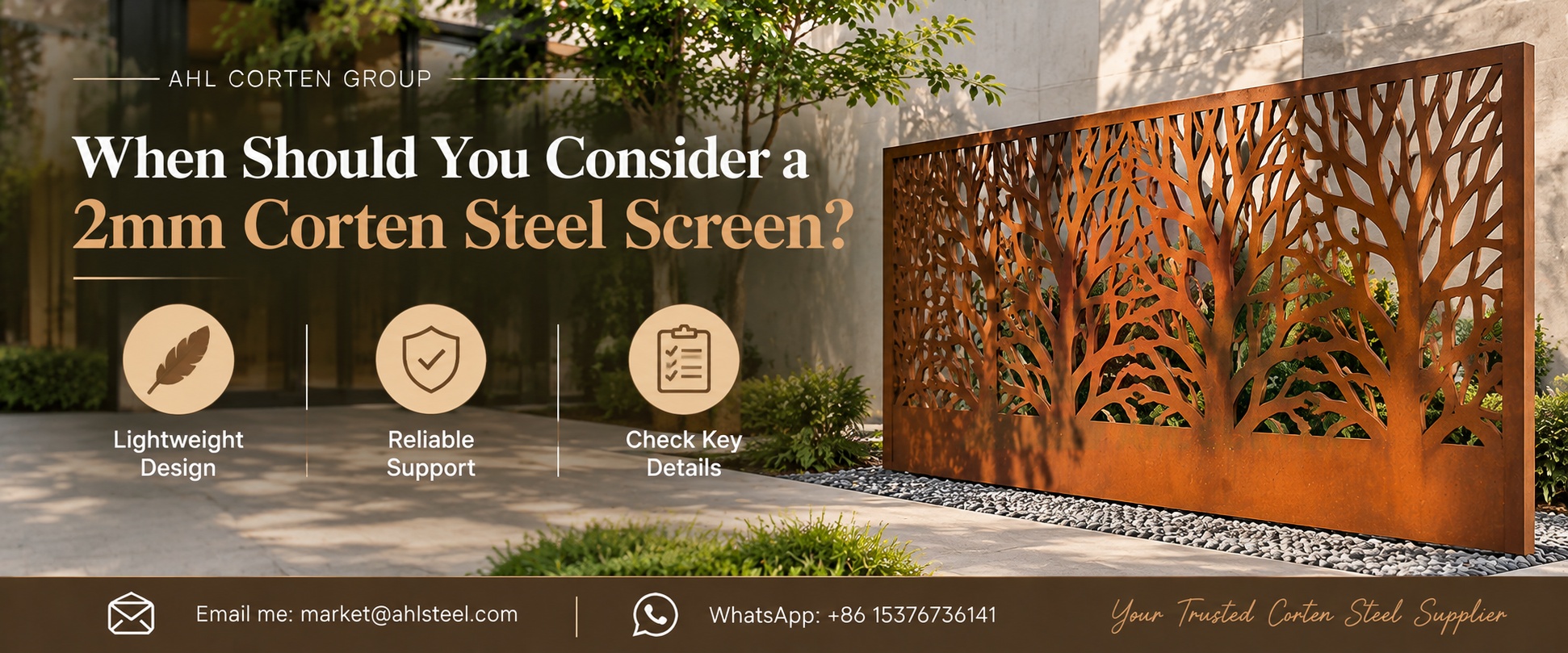
When Should You Consider a 2mm Corten Steel Screen?
1. When Lower Panel Weight Is a Priority
For corten steel fence panels of the same size and openwork pattern, 2mm sheets require less material and result in lighter panels. In decorative screen installations consisting of multiple panels, the weight-saving advantage is significant, reducing the difficulty of transportation, on-site handling, and hoisting.
However, a lightweight panel does not necessarily mean a simple installation. Uprights, brackets, and mounting hardware will still bear the load of the entire system, so the installation plan cannot be simplified.
2. When the Design Includes Suitable Support
When the decorative metal screen is equipped with a metal frame and secured to reliable wall supports, 2mm is a very cost-effective choice. The key consideration when selecting the thickness is the unsupported span, rather than the overall length and width of the panel. The shorter the span, the more stable the 2mm panel will be.
3. What to Confirm Before Ordering
Once you’ve selected the 2mm solution, verify the following conditions in advance: panel dimensions, purchase quantity, laser patterns, and the width of the perforated connecting ribs; whether flanging or matching frames are required; installation method (wall-mounted or freestanding); on-site wind conditions and mounting points; as well as drawings and installation details.
We recommend that distributors and project purchasers compare the complete configuration rather than focusing solely on the unit price of the panels.
When Is a 3mm Corten Steel Screen Worth Considering?
1. When a Project Requires Greater Panel Rigidity
Under the same support conditions, 3mm sheets offer better resistance to bending than 2mm sheets, making them suitable for large-scale privacy screens, freestanding outdoor screens, and applications that require high panel flatness.
However, there are still alternative solutions: edge folding, external framing, back bracing, and segmenting the panel. In many cases, these offer better value than simply using thicker sheet metal.
2. When the Installation Can Accommodate More Weight
3mm panels weigh approximately 50% more than 2mm panels, so the entire support system must be designed to handle this load. Pre-purchase verification: Determine whether existing columns and support structures can bear the panel weight; verify that bracket, bolt, and fastener specifications are compatible; assess whether hoisting equipment is required; and confirm whether packaging and transportation plans need to be adjusted.
For large-scale commercial projects, these details must be confirmed before production begins—do not wait until on-site installation to discover issues.
3. What 3mm Does Not Guarantee
Upgrading to 3mm panels does not mean: Automatic compliance with all wind load requirements; No need for a frame or reinforcement; Compatibility with existing fasteners; A longer service life in all environments; Complete resistance to bending or deformation.
The appropriate screen solution depends on the entire installation system, not just the thickness of the steel panels.
How Do Laser-Cut Patterns Affect Thickness Selection?
Perforations are a key selling point of weathering steel landscape screens, but the patterns directly determine panel strength and must be evaluated simultaneously during selection. Do not focus solely on the percentage of perforated area; instead, pay close attention to the shape of the remaining steel structure after perforation:
· Narrow connecting ribs between cutouts
· Slender decorative lines
· Isolated shapes with few connection points
· Fine decorative elements near the panel edges
· Connecting structures around mounting holes and folded edges
Whether 2 mm or 3 mm thick, designs featuring a large number of narrow connecting ribs require optimization.
Verify Patterns Based on Actual Production Dimensions
When the pattern files are scaled up or down, the width of the connecting ribs changes accordingly. Details that are suitable for small panels may become fragile when scaled up to large screens, increasing processing difficulty and making them prone to deformation or breakage. For continuous patterns composed of multiple panels, it is essential to verify pattern alignment, seam locations, panel edge allowances, and mounting hole positions—this is particularly important for commercial projects.
Do not assume that using thicker panels will solve all pattern-related issues. Complex cut-out designs still require simplifying details, widening connecting ribs, and adjusting support solutions. AHL can evaluate thickness and structural solutions based on panel dimensions, cut-out patterns, and manufacturing processes, and provide procurement recommendations.
Do 2mm and 3mm Screens Need Different Frames and Fixings?
The answer depends on panel size, installation method, and on-site conditions. Both 2mm and 3mm screens may require support structures; the frame and mounting solution must be determined by the overall design.
1. Wall-Mounted vs. Freestanding Screens
Wall-mounted screens: Key considerations include wall material, mounting points, bracket structure, and wall load-bearing capacity. For freestanding screens, the support system typically includes: metal columns, vertical supports, base plates, floor anchors, perimeter frames, concrete foundations, connecting brackets, and fasteners.
Freestanding screens experience entirely different loading conditions than wall-mounted ones; they are subject to greater wind loads and require a separate review of the mounting solution.
2. Panel Size and Wind Exposure Matter
For outdoor privacy screens, wind pressure is a major risk factor. Large, solid panels are subjected to significant wind forces, and the load depends on panel size, installation height, surrounding obstructions, and the proportion of openwork. The standards for decorative screens in sheltered courtyards are completely different from those for freestanding screens in open areas or at high, wind-exposed locations.
Do not assume that a 3mm panel is inherently wind-resistant; provide project details during procurement to conduct a specialized load assessment.
3. Confirm the Complete Set of Support Components When Requesting a Quote
When requesting a quote, clearly specify the scope of the list to the supplier: weather-resistant steel panels, folded edges, outer frames, support columns, brackets, mounting holes, connectors, base plates, and other installation accessories. For large-scale projects with high wind loads, it is recommended that load calculations and fastening solutions be reviewed by a professional structural engineer. Open-webbed decorative screens cannot be used directly as safety barriers or guardrails unless specific structural calculations have been performed.
Cost Comparison: Is 3mm Always More Cost-Effective Than 2mm?
The solution with the best value for money is not necessarily the one with the cheapest sheet material or the thickest gauge. When comparing 2mm and 3mm options, calculate the total production and installation costs for the entire system:
1. Material consumption: For solid panels of the same dimensions, 3mm requires approximately 50% more material, which directly affects the cost of the sheet material
2. Laser Cutting and Processing: Quotes are influenced by pattern complexity, cutting length, edge folding, welding, and reinforcement components
3. Frames and Accessories: Components such as posts, brackets, and base plates account for a significant portion of the total cost
4. Packaging and Shipping: Heavier panels increase packaging, hoisting, and logistics costs, which is particularly noticeable for large-volume orders
5. Order quantity, panel dimensions, and surface treatment processes also affect the final quote
A 50% increase in panel thickness does not result in a corresponding 50% increase in the total project cost. For a fair comparison, we recommend standardizing the panel dimensions, cutout patterns, surface finishes, and scope of supply, then requesting separate quotes for 2mm and 3mm panels to compare the panels’ dead weight, frame configurations, and processing requirements.
Request a Quote: Custom Weathering Steel Screens
The key to choosing between 2mm and 3mm is matching the project’s requirements, rather than simply selecting a thickness. AHL offers custom weathering steel screens for landscape, garden, and commercial projects, designing suitable solutions based on panel dimensions, laser-cut patterns, and fabrication processes.
Whether for decorative screens in private gardens or large-scale commercial landscape projects, providing complete technical documentation can significantly improve the efficiency of the quoting process. When contacting AHL, please provide: panel dimensions, purchase quantity, files of the cut-out patterns, preferred thickness (2mm/3mm or both for comparison), installation method, surface treatment, project location, and delivery requirements.
If you’re unsure which thickness to choose, simply send us the panel dimensions, patterns, installation method, and site information, and we’ll prepare a customized quote comparing options for thickness, framing, and mounting solutions.
FAQ
1. Is a 2mm Weathering Steel Screen Suitable for Outdoor Use?
Provided the panel dimensions are appropriate, the cutout patterns are well-designed, and a supporting frame is in place, 2mm panels can be used for outdoor decorative screens. For large-span, unsupported freestanding designs, we recommend adding reinforcements or selecting a thicker gauge.
2. Is a 3mm Screen Necessarily Better Than a 2mm One?
Not necessarily. Under identical conditions, 3mm offers greater resistance to bending, but it has a heavier weight and requires more rigorous handling and support. The optimal thickness depends on the overall screen design.
3. How Much Heavier Is a 3mm Panel Than a 2mm One?
For solid panels of the same material and dimensions, a 3mm panel uses approximately 50% more material than a 2mm panel; the final weight of the finished product must also account for material removed during laser cutting and any additional hardware.
4. Do 3mm Screens Still Require a Frame?
They may still require one. The panel size, unsupported span, wind exposure, and installation method determine whether a frame and reinforcement are needed. Thicker panels do not automatically eliminate the need for support.
5. What Thickness Is Suitable For Laser-Cut Patterns?
Both 2mm and 3mm panels can be used for laser-cut screens. The appropriate thickness depends on the complexity of the design, the width of the connecting ribs, the panel dimensions, and the processing conditions; the design must be verified based on actual production dimensions.
6. Can 2mm Panels Be Used for Freestanding Floor-to-Ceiling Screens?
Yes, but this requires a comprehensive assessment of panel dimensions, columns, base plates, floor anchors, and on-site wind conditions. Structural calculations are recommended before on-site installation.
7. Does a Thicker Panel Provide Better Privacy?
No. Privacy is primarily determined by the cutout pattern, hole size, panel arrangement, and viewing angle. For the same pattern, a 3mm panel does not provide better privacy than a 2mm panel.
8. Does 3mm Corten Steel Have a Longer Service Life Than 2mm?
Not necessarily. Service life depends on steel quality, environmental humidity, drainage, and fabrication and installation processes; thickness alone cannot guarantee longevity.
9. Can I Request Quotes for Both Thicknesses at The Same Time?
Yes. Specify fixed dimensions, patterns, quantities, surface finishes, and scope of supply, and ask the supplier to provide two proposals for comparison. This will help you evaluate differences in dead weight, fabrication costs, and total project costs.
Back

 Fill In The Inquiry