How to Choose Corten Steel Fire Pit Thickness: 3 mm vs. 4 mm vs. 5 mm
When purchasing weathering steel fire pits, many buyers fall into a common misconception: the thicker the steel plate, the better and more durable the product.
In reality, plate thickness directly affects material usage, weight, structural stability, and logistics costs, making it a key factor in product selection and pricing. However, simply choosing the thickest plate is not necessarily the most economical or appropriate solution.
Corten fire pits that appear similar on the surface can have vastly different structural requirements for the steel plate due to variations in diameter, depth, support structure, heat exposure, and intended use.
This article compares three mainstream specifications—3mm, 4mm, and 5mm—to help retailers, wholesalers, and landscape engineering buyers clarify the logic behind product selection. We do not treat thickness alone as a guarantee of durability but instead conduct a comprehensive evaluation that takes into account the entire structure and operating conditions.
For B2B buyers, decision-making must also extend to packaging, handling, shipping costs, budget, and target market preferences. The core of product selection is matching the application scenario, not simply increasing the amount of steel used.
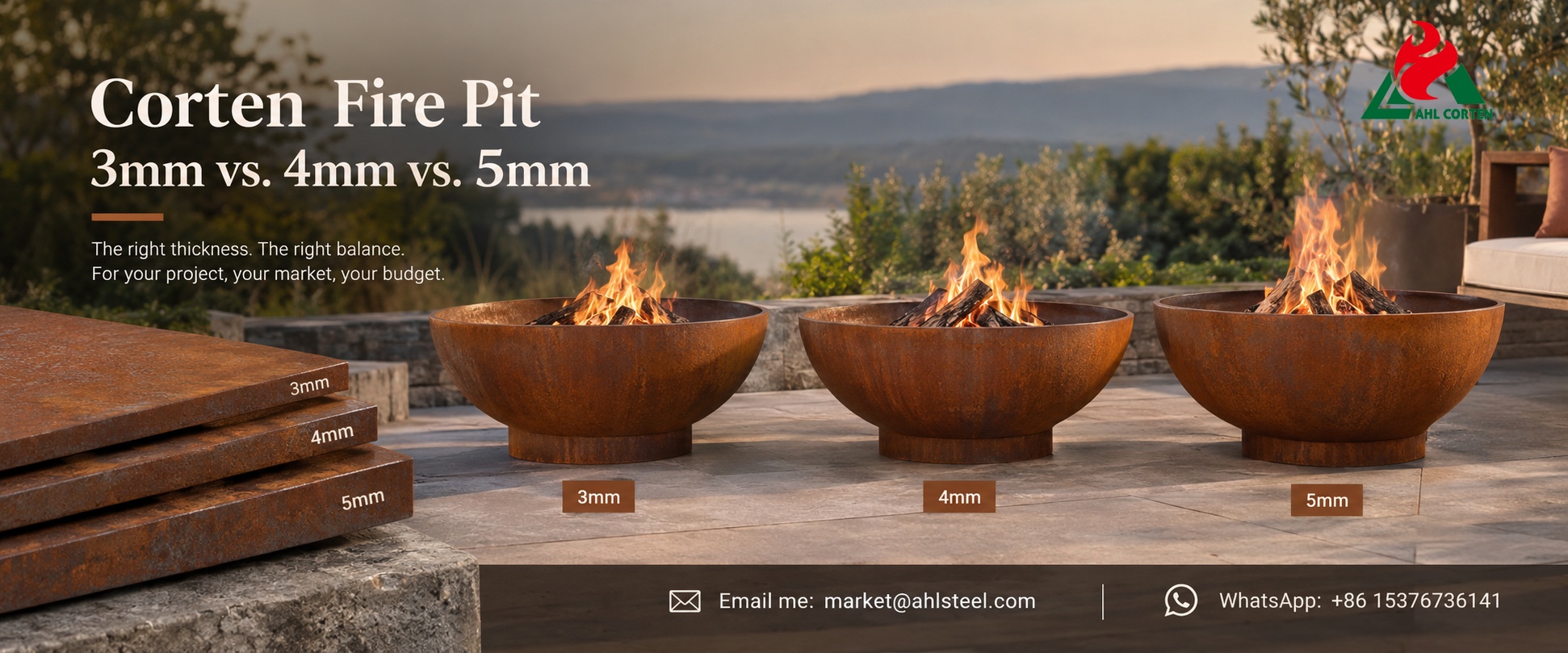
Quick Answer: Which Thickness Should You Choose?
Choose thickness as part of the complete fire-pit design—not as a guarantee of durability. Commercial products include 3 mm bowls and customisable 3–5 mm constructions, but suitability must be confirmed for the specific model and intended use.
| Thickness |
Potential Buying Priority |
Main Trade-Off |
What to Verify |
| 3 mm |
Lower weight and initial material cost |
Less material reserve than thicker alternatives |
Bowl shape, support and intended firing conditions |
| 4 mm |
An intermediate specification |
More weight than an equivalent 3 mm shell |
Whether the design benefits from the additional thickness |
| 5 mm |
Greater section thickness for heavier designs |
Higher material weight and handling demands |
Reinforcement, base support and delivery access |
These are comparison principles, not structural approvals or lifespan predictions.
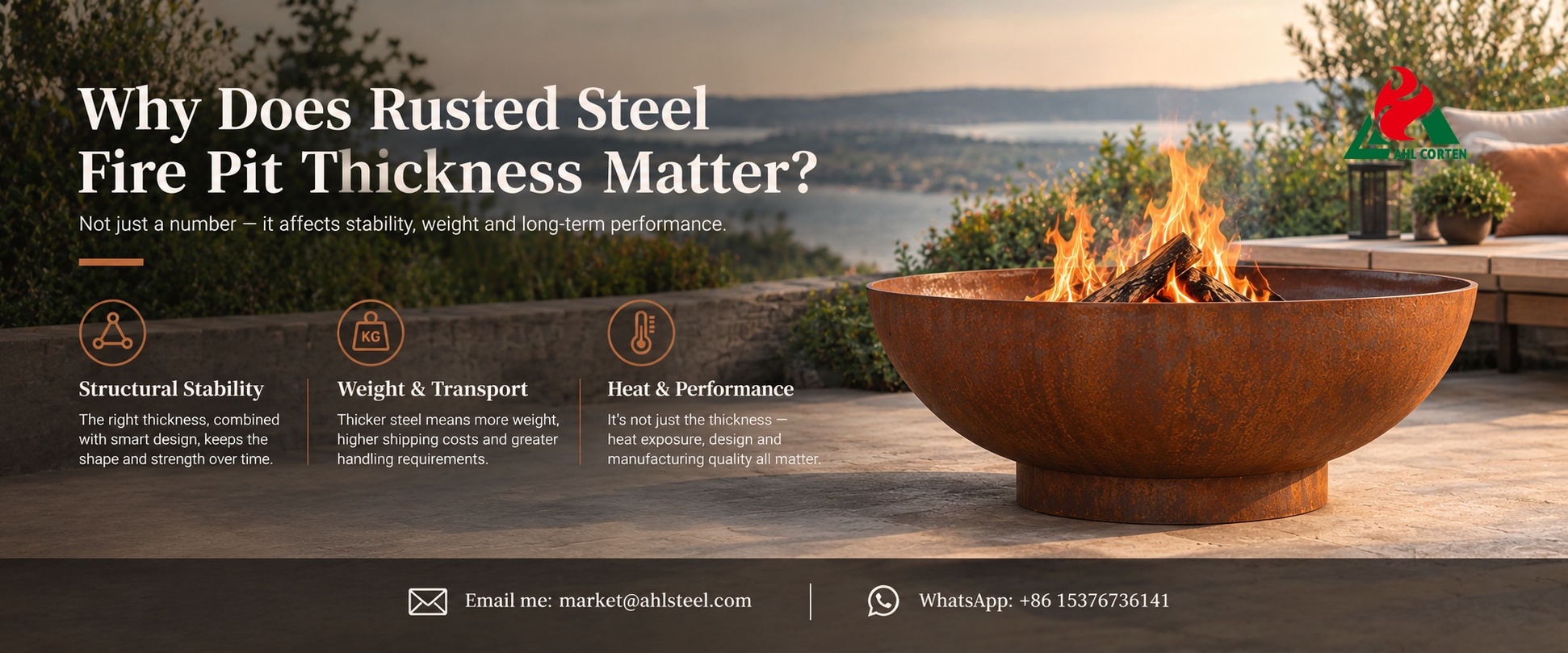
Why Does Rusted Steel Fire Pit Thickness Matter?
1. Structural Stability and Shape Retention
Thickness increases the rigidity of sheet metal, but it cannot be evaluated in isolation from the overall structure.
The diameter, depth, rolled-edge design, and base support method of a fire bowl collectively determine whether it will deform after prolonged exposure to heat.
Large-diameter fire bowls require additional reinforcing ribs, wider rolled edges, or an optimized base—rather than relying solely on thicker steel plates.
A truly durable fire bowl results from the right combination of appropriate sheet thickness and well-designed structural details—not from blindly choosing the heaviest steel.
2. Weight, Handling, and Transportation
The thicker the steel sheet, the heavier the finished product, and this weight increases proportionally with the bowl’s surface area.
Thicker models require sturdier packaging and more careful loading and unloading, which directly drives up shipping costs.
For dealers, this impacts warehouse turnover, showroom displays, and last-mile delivery.
Heavy products may give customers a sense of solid quality, but they also drive up delivery costs and make it harder for end users to move and install them. When purchasing, be sure to check the total weight after packing, palletization plans, and handling requirements—don’t just look at the sheet metal thickness.
3. Heat Exposure and Material Performance
The performance of a rusted steel fire pit is determined by a combination of factors: heat load, flame position, ventilation design, pit shape, welding techniques, and manufacturing quality.
The behavior of steel plates in areas subjected to continuous high-temperature exposure differs significantly from that in cooler outer areas.
Thicker steel plates do not automatically equate to a longer service life.
The high-quality corten fire bowl design manages heat distribution and the thermal expansion and contraction of the steel plates across the entire system. When comparing products, review the complete structural specifications rather than focusing solely on thickness parameters.
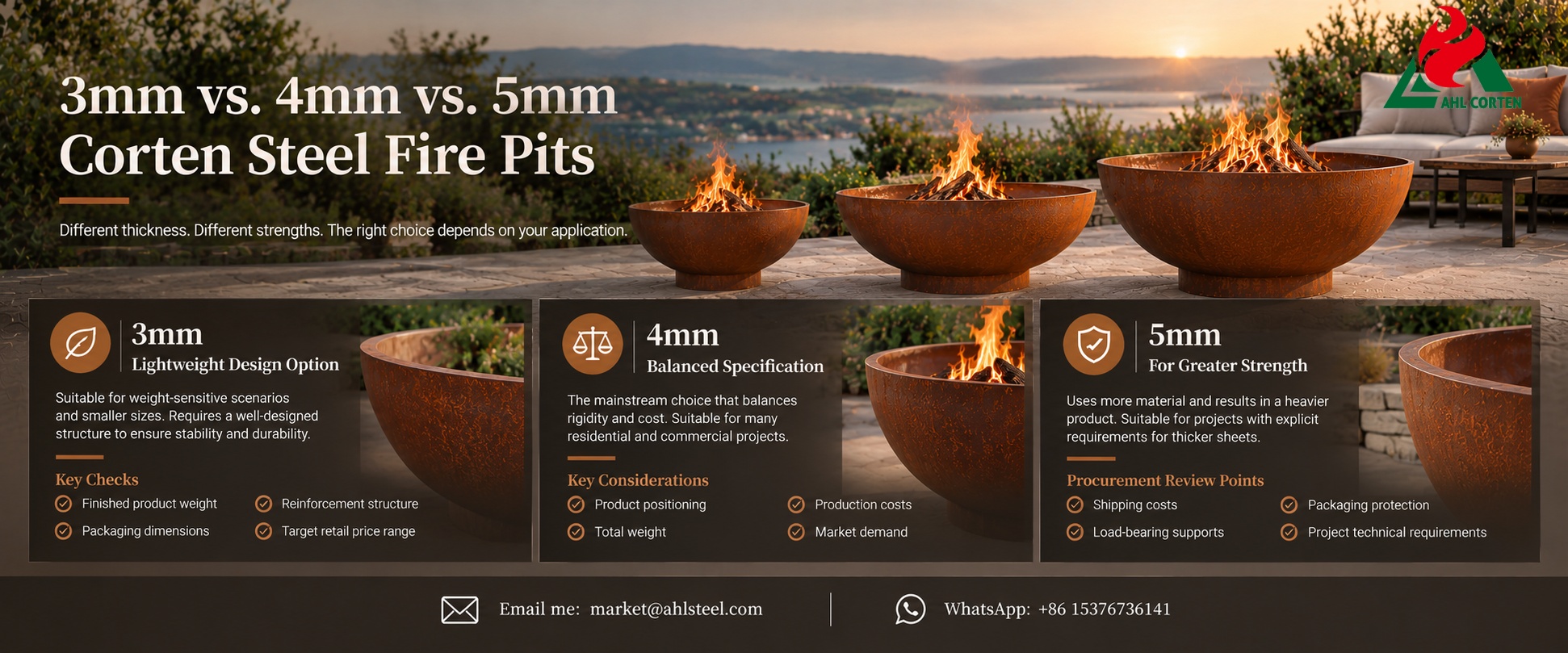
3mm vs. 4mm vs. 5mm Corten Steel Fire Pits
| Comparison |
3 mm Corten Steel |
4 mm Corten Steel |
5 mm Corten Steel |
| Main Buying Priority |
Lower weight and lower material cost |
A balance between weight and additional thickness |
Heavier construction where portability matters less |
| A Good Starting Point For |
Residential garden bowls and designs that require occasional repositioning |
Larger bowls or custom designs needing more substantial construction |
Large-format bowls and permanent outdoor installations |
| Relative Steel-Shell Weight* |
Lightest: baseline |
Approximately 33% heavier than 3 mm |
Approximately 67% heavier than 3 mm |
| Material Budget* |
Lowest of the three |
Intermediate |
Highest of the three |
| Moving and Installation |
Easier to handle, depending on overall size |
More handling effort |
Plan lifting, delivery access and base support |
| What to Check Before Ordering |
Bowl shape, rim design and support |
Whether extra thickness or reinforcement best suits the design |
Component thicknesses, total weight and installation requirements |
| Choose This If… |
“I want a lighter fire bowl and need to control the budget.” |
“I want a middle-ground option without choosing the heaviest construction.” |
“I want a substantial, fixed installation and accept the extra weight and cost.” |
*Weight comparisons assume the same steel grade, developed surface area and component design; they refer to the steel shell, not the complete product. Material-budget comparisons assume equivalent specifications and exclude fabrication, accessories and delivery.
These options are starting points, not universal specifications. Confirm the final thickness against the fire pit’s size, shape, construction and intended use.
-
3mm Corten Fire Pit – A Lightweight Design Option
3mm weathering steel fire bowls are suitable for weight-sensitive scenarios requiring easy portability and are commonly used for smaller sizes.
This is only true if the pit’s shape, base, and reinforcement structures are specifically designed around this plate thickness.
One cannot assume, based solely on thickness, that it is suitable for all sizes and usage intensities.
Key procurement verification points: finished product weight, outer packaging dimensions, reinforcement structure, reinforcement details, and target retail price range.
-
4mm Corten Patio Fire Pit – A Balanced Specification to Consider
4 mm is the mainstream choice on the market that balances structural rigidity and material cost.
For the same design, it strikes a balance between weight, production cost, and rigidity, serving as the benchmark when comparing lightweight and heavy-duty models.
However, it is not a one-size-fits-all standard; suitability still depends on the rim diameter, support structure, ventilation design, and frequency of use.
Key Procurement Considerations: Product positioning, total weight, production costs, and target market demand.
-
5mm Corten Backyard Fire Pit – For Designs Requiring Greater Section Thickness
5 mm sheets require more material and result in a heavier finished product; they are generally used for projects with explicit requirements for thicker sheets.
With increased thickness, packaging solutions, lifting and handling procedures, and logistics planning must all be adjusted accordingly.
It is only worth incurring higher material and logistics costs when the entire structure genuinely requires greater cross-sectional strength.
Important Reminder: Do not claim that 5mm fire pits are inherently superior to 3mm models; durability cannot be measured solely by thickness.
When making comparisons, select products that are of the same size, have similar construction, and are intended for the same conditions of use.
Procurement Review Points: Shipping costs, load-bearing supports, packaging protection, and project technical requirements.
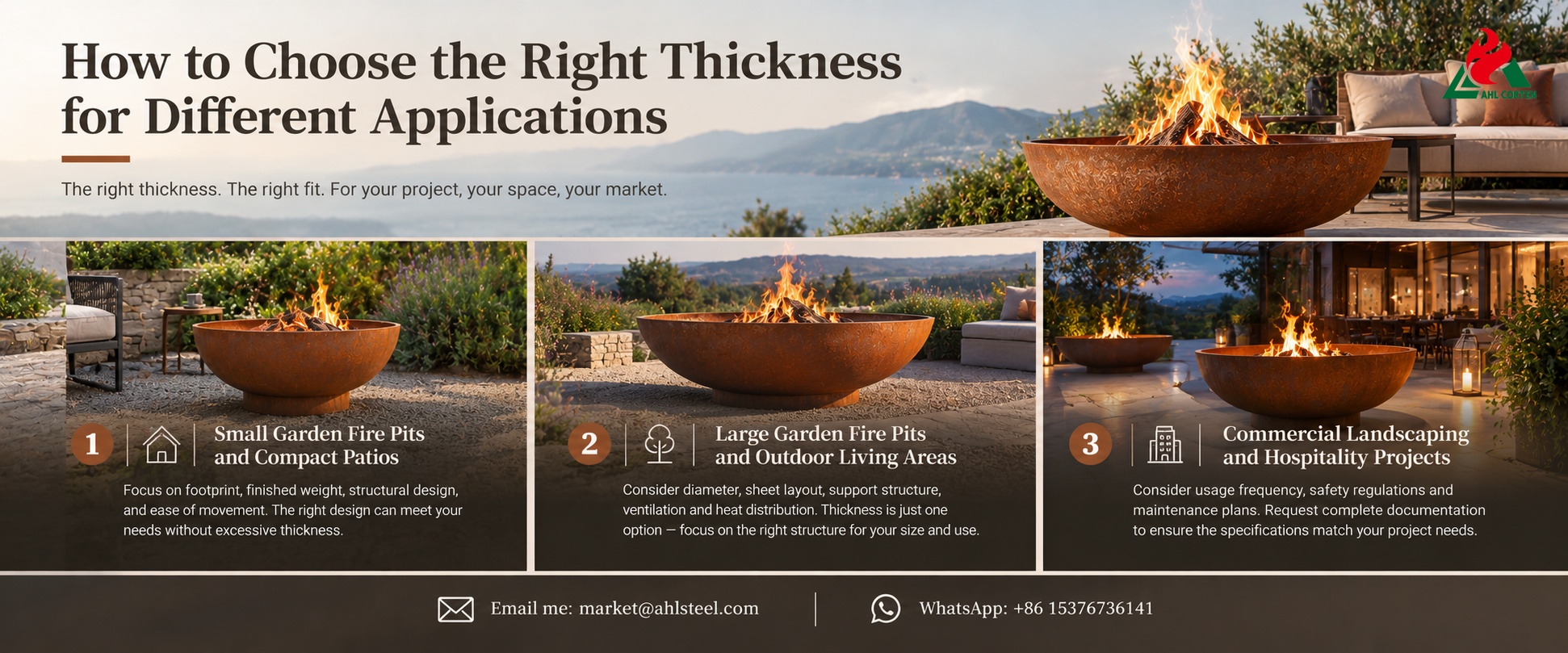
How to Choose the Right Thickness for Different Applications
1. Small Garden Fire Pits and Compact Patios
For small patios, priority should be given to footprint, finished weight, structural design, and ease of daily movement.
If the Corten fire pit ring body, base, and supports are properly designed, lightweight specifications can meet the requirements.
For retailers, packaging dimensions and the difficulty of warehousing and handling are sometimes just as important as the steel specifications.
2. Large Garden Fire Pits and Outdoor Living Areas
Large fire pits require a comprehensive evaluation of diameter, sheet metal layout, support structure, ventilation, and heat distribution.
Thicker steel plates are merely one option and cannot replace sound structural design.
When purchasing, focus on confirming the bowl’s support method, how high-temperature hot spots are managed, and solutions for thermal expansion. The appropriate specification should match the size and intended use, rather than simply choosing thicker plates.
3. Commercial Landscaping and Hospitality Projects
Commercial settings such as hotels, restaurants, and public landscapes involve higher usage frequency and public safety regulations, making them entirely different from residential settings.
Before purchasing, confirm design requirements, frequency of use, maintenance plans, and site safety regulations.
Request complete drawings, material certificates, installation guides, and maintenance instructions to ensure specifications align with the project’s operational needs; do not rely solely on a single thickness metric.
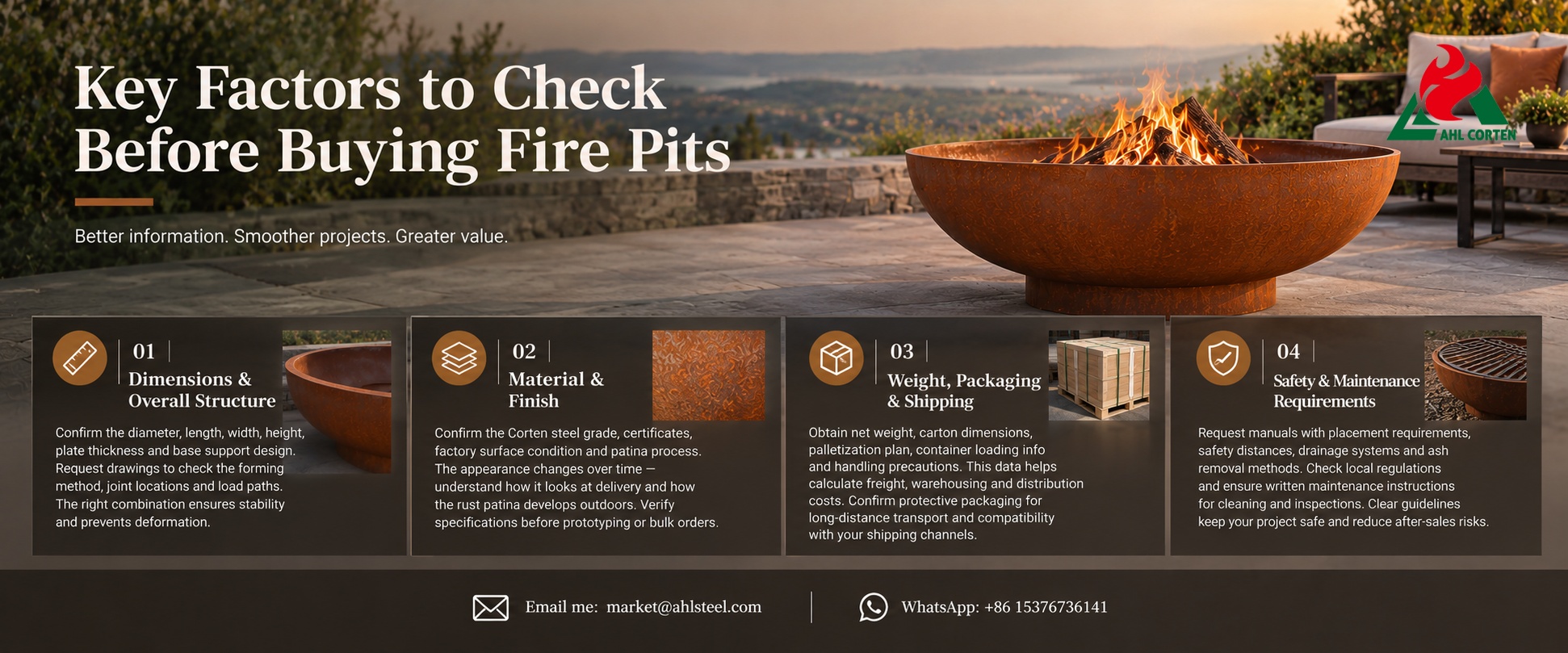
Key Factors to Check Before Buying Fire Pits
1. Fire Pit Dimensions and Overall Structure
Confirm the diameter, length, width, and height, as well as the plate thickness and base support design.
Request drawings to examine the forming method of the basin, joint locations, and load-transfer paths.
These factors work together to determine stability and resistance to deformation. Product specifications should be evaluated as a whole, rather than as a list of isolated parameters.
2. Material Specifications and Finish
Confirm the corten steel grade, material certificates, factory-finished surface condition, and the natural patina development process.
The appearance of corten steel will continue to change over time; the buyer must understand its appearance at the time of delivery as well as how the rust patina will develop when placed outdoors.
Before proceeding with prototyping or placing bulk orders, verify the material specifications to ensure the finished product aligns with the design and market positioning.
3. Weight, Packaging, and Shipping
Obtain the net weight per unit, outer carton dimensions, palletization plan, container loading information, and loading/unloading precautions.
This data is essential for accurately calculating freight, warehousing, and distribution costs.
B2B procurement places particular emphasis on protective packaging; confirm the protective measures for long-distance transport and whether they are compatible with your shipping channels.
4. Safety and Maintenance Requirements
Request product manuals that include placement requirements, safety distances from flammable materials, drainage systems, and ash removal methods.
Simultaneously verify local regulations at the project site.
Maintenance instructions must also be documented in writing, covering routine cleaning and periodic structural inspections. Clear guidelines ensure safe use and minimize post-sale disputes.
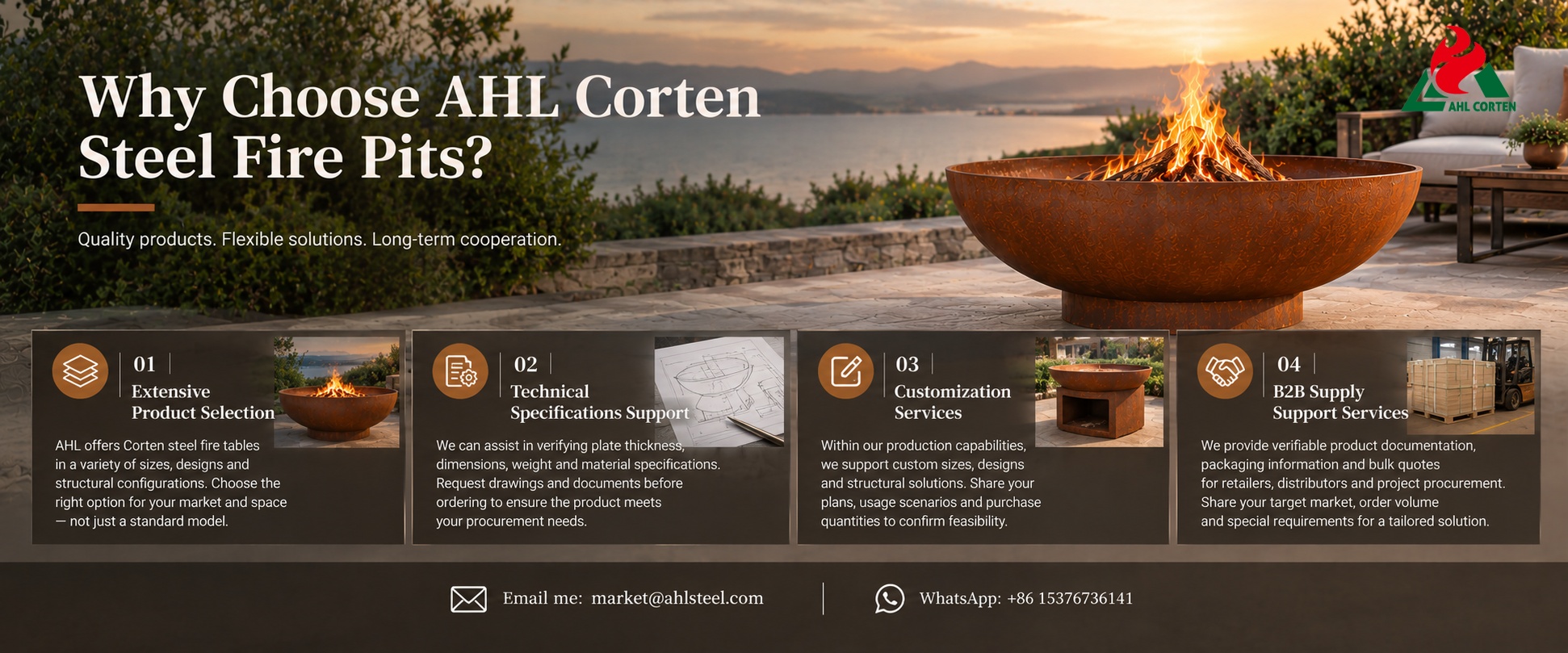
Why Choose AHL Corten Steel Fire Pits?
1. Extensive Product Selection
AHL offers Corten steel fire tables in a variety of sizes, designs, and structural configurations.
Buyers can select options based on their target market, installation space, and product positioning—rather than being limited to a single standard model.
2. Technical Specifications Support
AHL can assist in verifying plate thickness, dimensions, weight, and material specifications.
Request drawings and specification documents before placing an order to ensure the finished product meets your procurement requirements.
3. Customization Services
Within our production capabilities, we support custom sizes, designs, and structural solutions.
Share your design plans, usage scenarios, and purchase quantities with us to confirm the feasibility of customization.
4. B2B Supply Support Services
For retailers, distributors, and project procurement, we provide verifiable product documentation, packaging information, and bulk quotes.
Simply inform us of your target market, estimated order volume, and any special project requirements to receive a tailored solution.
Frequently Asked Questions
1. What Is the Optimal Thickness for a Weathering Steel Fire Pit?
There is no universal “optimal” thickness. The appropriate specification depends on the size of the Corten wood burning fire pit, structural design, support configuration, heat exposure, and intended use. You must evaluate the entire product as a whole—thickness alone is not sufficient.
2. Is a 3mm Weathering Steel Fire Pit Sufficient?
For certain small models or designs with specially optimized structures, 3mm is feasible. However, it cannot be assumed to be suitable for all sizes or applications; the complete structural design must be verified.
3. What Are the Key Differences Between 3mm, 4mm, and 5mm Weathering Steel Fire Pits?
The main differences lie in steel consumption, weight, rigidity, and cost, which directly impact handling, packaging, and transportation. However, actual performance depends heavily on the fire pit’s dimensions, welded construction, and usage conditions.
4. Does a Thicker Steel Plate Mean a Longer Lifespan For The Fire Pit?
Not necessarily. Service life is determined by the overall design, including heat distribution, support structure, ventilation, weld quality, and ongoing maintenance. Thickness is just one factor and cannot be used alone as a criterion for durability.
5. How Does Thickness Affect Weight and Shipping Costs?
As thickness increases, material usage and weight rise accordingly, directly affecting loading/unloading plans, packaging standards, and freight charges. When calculating the landed cost, it is essential to obtain the packing weight and outer carton dimensions for the specific specifications.
6. Can Corten Patio Fire Pits Be Customized To Different Thicknesses?
Custom thicknesses are available, but they are subject to limitations regarding manufacturing processes, minimum order quantities, and lead times. Before placing a formal order, confirm feasibility, tooling requirements, minimum order quantities, and delivery schedules with the manufacturer.
7. What Specifications Should Distributors Confirm Before Placing An Order?
Diameter, height, sheet thickness, weathering steel grade, material certification, net weight, packaging dimensions, structural reinforcement details, surface finish, installation instructions, and maintenance requirements—to avoid specification mismatches and ensure accuracy.
Choosing the Right Corten Fire Pit for Your Business
Choosing between 3mm, 4mm, and 5mm weathering steel fire pits involves more than just comparing steel thickness. Product dimensions, structural design, weight, shipping costs, and intended use all play a significant role in selecting the right specifications for your market.
At AHL Weathering Steel Group, we are committed to helping retailers, wholesalers, distributors, and project buyers explore outdoor fire pit solutions that meet the needs of their product lines and projects.
Whether you’re sourcing compact garden fire pits or larger, statement pieces, our team can help you identify available specifications and customization options.
Ready to expand your outdoor living product line? Contact AHL today to request a catalog, discuss your required specifications, and get a quote based on your target order volume. Let’s work together to find the right rusted steel fire pit solution for your business.
Want the Latest Price Lists for Corten Steel Fire Pits? Contact Us!
 Fill In The Inquiry