Can You Use a Corten Steel Fire Pit on Gravel
Weathered steel fire pits are a popular outdoor fire feature in yards, patios, and vacation home landscapes. Many homeowners and landscape designers ask the same question: Can a weathering steel fire pit be placed directly on a gravel surface?
Simply put, as long as the ground is properly prepared, a corten steel fire pit can certainly be placed on gravel. Gravel itself is a non-combustible material and is well-suited as a base for a fire pit, but simply laying a layer of gravel does not guarantee safety.
For stable and safe use, the ground must be level and firm, with good drainage, while also complying with the safety distances specified in the product manual and local fire codes.
This article will explain in detail the conditions for using a gravel base, installation steps, safety standards, and compatible outdoor steel fire pit models to help you avoid installation risks.

Is a Gravel Surface Suitable as a Base for a Corten Fire Pit?
1. Advantages of Gravel as a Fire Pit Base
Gravel itself is non-flammable, making it a natural choice for designated fire pit areas in outdoor settings. Additionally, the rough, natural texture of gravel complements the weathered rust finish that gradually develops on weathering steel, making it a popular choice for garden landscaping.
Gravel also has a very practical feature: it can absorb the initial rust runoff from weathering steel, reducing the spread of rust stains to surrounding light-colored surfaces. AHL lists gravel alongside concrete, pavers, and specialized heat-resistant mats as recommended base surfaces for fire pit installation.
2. The Hidden Risks of Gravel Surfaces
Loose, uncompacted gravel can easily shift under the weight of the fire pit. If the underlying foundation is not leveled properly, the fire pit may tilt or sink, posing significant safety hazards.
Fine gravel or underlying soil provides poor drainage, leading to water accumulation. If the bottom of a weathering steel fire pit is in prolonged contact with a damp surface, it accelerates rusting. Furthermore, if the drainage holes at the bottom become clogged with silt and sand, the water accumulation problem will become even more severe.
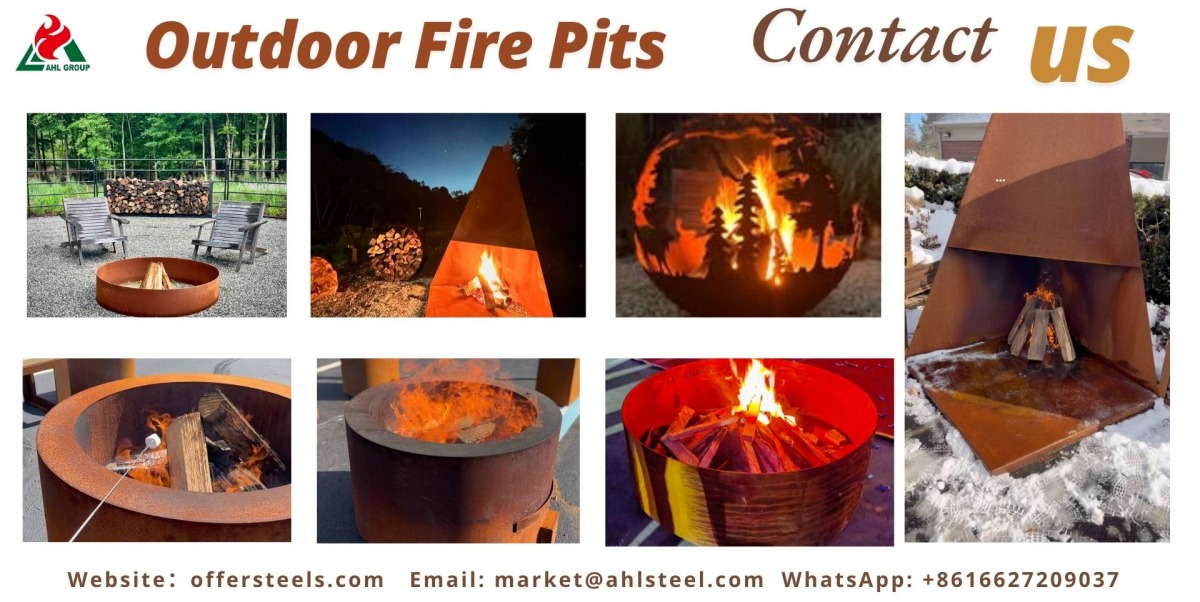
Types of Gravel Suitable for Backyard Corten Fire Pits
1. Crushed Stone: Creating a Stable, Load-Bearing Base
After compaction, angular crushed stone interlocks with neighboring stones, providing greater stability. This is the preferred material for the area where the fire pit is directly placed. It is best suited as a load-bearing base layer, rather than simply laid as a decorative layer.
Once the crushed stone is laid, the surface must be level to evenly support the full weight of the fire pit, ashes, and firewood, preventing localized sinking.
2. Pebbles: Suitable for Perimeter Decorative Areas
Rounded pebbles have a soft, attractive appearance and are ideal for landscaping the outer perimeter of a fire pit on a gravel patio. However, because the grains are smooth and lack interlocking, they tend to shift under weight and are not suitable for placement directly beneath the fire pit.
Pebbles can be laid around the perimeter of the fire pit to catch dripping rust water and protect the surrounding paving; however, a stable, compacted base is still required beneath them, and it is best to install a border to prevent the pebbles from scattering.
3. Important Reminder: Do not use loose, untreated gravel as a foundation alone.
Before selecting gravel, assess the existing soil conditions. Remove organic matter such as grass roots and humus from the surface layer in advance, and install a compacted subbase if necessary.
There is no universal standard for gravel thickness; the specific thickness depends on the existing foundation, drainage conditions, the weight of the fire pit, and local construction codes. Don’t simply copy someone else’s design.
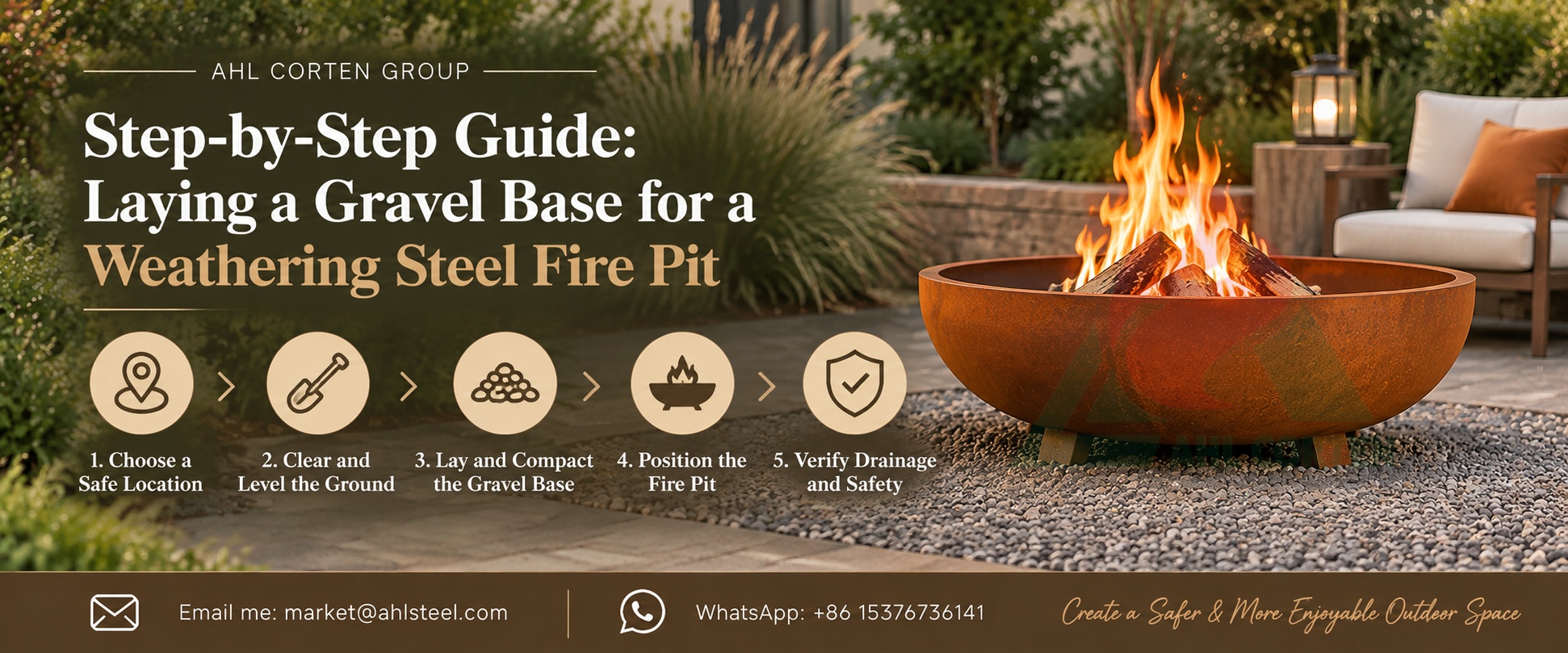
Step-by-Step Guide: Laying a Gravel Base for a Weathering Steel Fire Pit
Step 1: Choose a Safe Location
The fire pit should be placed away from house walls, wooden fences, pergolas, tree branches, wooden furniture, and plants. AHL recommends a safety distance of 3–7.6 meters (10–25 feet), which is consistent with U.S. fire department guidelines.
Before selecting a location, be sure to check your local regulations on outdoor burning to confirm that outdoor fire pits are permitted in your area and to avoid violations.
Step 2: Clear and Level the Ground
Clear the installation area of all weeds, tree roots, fallen leaves, and loose, decayed soil, then level the foundation.
The fire pit must be placed on a well-ventilated, hard, and stable surface. Ensure that the drainage holes are not blocked by soil or gravel so that rainwater and rusty water can drain away smoothly.
Step 3: Lay and Compact the Gravel Base
In areas where the ground is soft, first lay a subbase, then lay the gravel in layers, compacting each layer as you go and repeatedly checking for levelness.
There is no fixed standard thickness; a thicker base layer is required for soft soil, while a slightly thinner layer is acceptable for hard, well-drained natural ground. The primary goal is to ensure the structure does not wobble or sink after compaction.
Step 4: Position the Fire Pit and Check Stability
Place the rusted steel fire pit on the prepared gravel surface and check that it sits level, without wobbling or hanging off one side.
AHL recommends leaving a 5–10 cm gap between the bottom of the fire pit and the ground. Use support feet to raise it off the ground to prevent direct heat transfer to the ground below and to facilitate ventilation and drainage. Before placing an order, confirm whether the model comes with support feet and a base plate.
Step 5: Verify Drainage and Safety Clearances
Ensure no water accumulates around the fire pit; prolonged exposure to standing water will accelerate the aging of the steel. Also, clear away any dry grass, mulch, or flammable decorations from the surrounding area—sparks can travel a certain distance, so no flammable materials should be present nearby.
You can also place firebricks under the fire pit to further block moisture; never place it directly on damp grass or bare soil.
Core Safety Guidelines for Corten Steel Fire Pits on Gravel Surfaces
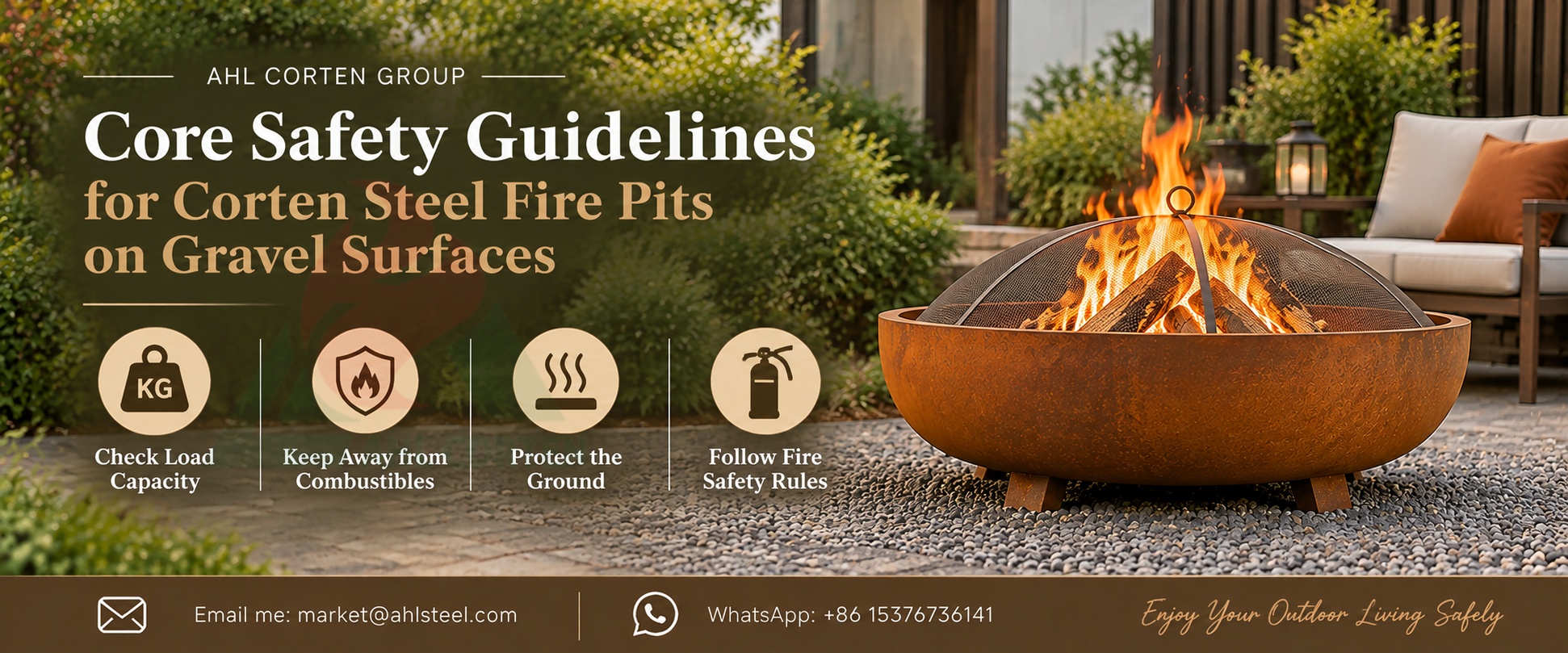
1. Check the Load-Bearing Capacity of the Fire Pit Base and Foundation
When calculating the total weight, do not account for the empty backyard fire pit alone; include the weight of firewood, ashes, and accessories. Heavy-duty fire pits should never be placed directly on loose, uncompacted gravel.
Confirm the fire pit’s support structure in advance to determine whether the support legs and base plate are suitable for a gravel foundation.
2. Isolate from Surrounding Combustible Materials
Firewood, dry leaves, outdoor wooden furniture, and fabric decorations must be placed at a safe distance; do not light a fire beneath low-hanging tree branches.
It is recommended to use a fire-resistant spark guard to block flying sparks and prevent them from landing on distant combustible materials and causing accidents.
3. Understanding Heat Conduction and Protecting the Ground
Gravel itself does not burn, but the heat radiating downward from the fire pit will still affect the underlying ground.
If the fire pit has a flat bottom and is not elevated, a fire-resistant heat-insulating mat must be placed between the fire pit and the gravel to protect the ground below; this is often specified in the product manual.
4. Follow Fire Safety Rules and Be Prepared for Emergencies
Never leave an outdoor fire unattended; always keep a water source or dry sand nearby for fire suppression.
Do not use a fire pit made of weather-resistant steel in enclosed or poorly ventilated spaces to prevent carbon monoxide buildup and poisoning.
Which Styles of Corten Steel Fire Pits are Best Suited for Gravel Surfaces?
1. Round Weathering Steel Fire Bowls
Round fire bowls feature a simple, classic design that’s perfect for social gatherings in the backyard, and they come in a wide range of sizes.
When selecting a fire bowl, choose a diameter based on the number of guests and the size of the space. Be sure to leave a safe clearance around the fire bowl, as larger models require a more stable base.
2. Square and Rectangular Weathering Steel Fire Pits
Square and rectangular designs feature clean, sharp lines, making them ideal for modern geometric landscapes. They pair harmoniously with hardscaped surfaces and neatly arranged gravel areas.
Although compact square fire pits take up minimal space, they must still be placed on a level, non-combustible, compacted gravel surface—do not skimp on the foundation preparation.
3. Elevated Fire Pits vs. Ground-Level Fire Pits
Elevated models come with built-in support structures, creating a gap between the bottom and the gravel. This provides better ventilation and drainage, prevents heat from being directly transferred to the ground, and offers greater tolerance for minor imperfections.
Ground-level models fit snugly against the ground, creating a stronger sense of integration with the landscape. However, they impose stricter requirements on the foundation, drainage, and thermal insulation, necessitating special attention to moisture protection and thermal insulation.
When selecting a fire pit, don’t focus solely on appearance; pay close attention to the base structure, weight, drainage design, and the manufacturer’s installation instructions.

Maintenance Tips for Rusted Steel Fire Pits in Gravel Areas
1. Regularly Clean the Gravel Area
After each use, promptly remove scattered ashes and fallen leaves, and regularly check the gravel for shifting or sinking. If the gravel has been scattered or has sunk, promptly replenish it, then re-level and compact the area.
Develop the habit of conducting regular inspections, paying particular attention to whether drainage channels are unobstructed and whether any new flammable debris has accumulated around the perimeter.
2. Regularly Inspect the Condition of the Fire Pit Base
Frequently check whether the fire pit is tilting or sinking, and whether the supporting structure remains intact.
If you notice that the fire pit is tilted, the bottom is severely rusted, or the structure is deformed, stop using it immediately. Inspect the foundation and the fire pit itself, and only resume use once safety has been confirmed.
3. Understanding the Weathering Process of Weathering Steel
Weathering steel naturally develops a protective rust patina; this is a normal phenomenon. In the early stages, rust water will drip down and stain surfaces, so gravel is an ideal material to catch it.
Light-colored stone and tile surfaces are easily stained by rust, so in such settings, prioritize using gravel or dark-colored firebricks to absorb the rust water.
Why Choose Custom Weathering Steel Fire Pits for Outdoor Projects?
Custom weathering steel fire pits can be freely adjusted in diameter and height to suit the layout of your courtyard or the dimensions of your commercial space, making them ideal for private gardens, hotels, resorts, restaurants, and other settings.
Both the steel thickness and the base support structure can be customized. When purchasing, request a complete installation manual, which includes placement requirements, safety distances, drainage, and ash removal guidelines.
AHL supports OEM/ODM customization and offers bulk supply services. Landscape architects and wholesalers can customize dimensions, logos, and structural designs according to project requirements.
FAQ
1. Can the Fire Pit Be Placed Directly On the Gravel?
Yes, provided that the gravel base is compacted, level, and stable, and meets the manufacturer’s requirements for the base and safety clearances.
2. Is Pea Gravel Suitable for Use Under a Fire Pit?
Pea gravel is suitable for decorative edging but is not suitable for directly supporting the weight of a fire pit. If used, a compacted crushed stone base must be installed underneath, and the edges must be properly finished.
3. How Thick Should the Gravel Layer Under the Fire Pit Be?
There is no uniform standard; it depends on the original soil conditions, drainage, and the weight of the fire pit. A thicker base layer is required for soft ground.
4. Is an Additional Base Plate Needed on Top of the Gravel?
Not necessarily; it depends on the metal fire pit model. Some flat-bottomed models require a base plate, support legs, or heat-insulating pads, while raised models can omit these if their structure meets specifications.
5. Will a Steel Fire Pit Damage the Gravel?
Gravel itself is not susceptible to burning, but high temperatures, ash, and rusty water can cause cosmetic changes. Ensure proper drainage and a container to catch rusty water.
6. Can Sparks Ignite a Gravel Surface?
Gravel itself is non-flammable; the risk comes from nearby dry grass, wood shavings, or wooden furniture. Maintaining a sufficient safety distance and using a spark guard will prevent this.
7. What Is the Best Surface for a Weathering Steel Fire Pit?
Compacted gravel, concrete, stone pavers, and specialized fire-resistant heat-insulating mats are all suitable base surfaces recommended by AHL.
8. Can a Heavy-Duty Fire Pit Be Placed On Loose Gravel?
This is not recommended, as loose gravel can easily collapse or shift. A compacted, stable base must be prepared first.
9. Does a Corten Steel Fire Pit Require a Fire-Resistant Mat?
It is not a mandatory requirement, but we recommend installing a fire-resistant heat-insulating mat for flat-bottomed, unsupported models or when the underlying surface cannot withstand high temperatures.
Are You Ready to Choose the Perfect Outdoor Weathering Steel Fire Pit Solution for You?
A gravel surface is an excellent installation base for weathering steel fire pits. The three key factors are: a stable and level foundation, proper drainage, and adequate safety clearance.
If you’re looking for weathering steel fire pits for a courtyard project or hotel landscaping, check out AHL’s weathering steel fire pit series, or inquire about custom sizes, structural solutions, and wholesale pricing. Before placing an order, be sure to confirm in writing the base style, installation surface requirements, and safety standards to ensure the final result meets expectations and is safe to use.
Want the Latest Catalog for Rusted Steel Fire Pits? Contact Us!
Back


 Fill In The Inquiry