For most people, a flower pot is simply a container for growing plants. But for garden owners who pursue the ultimate in landscape aesthetics, it is much more than that—it is the cornerstone of spatial composition, a visual anchor that defines style, and an indispensable element of the garden’s “architectural language.”
Many gardens appear beautiful at first, but as the seasons change, the shortcomings of ordinary planters gradually become apparent: plastic planters fade and become brittle under strong sunlight; ceramic planters are fragile and difficult to integrate into modern landscapes; wooden planters rot and mold under the long-term erosion of damp soil, damaging plant roots and turning what should be a therapeutic gardening experience into a tedious annual chore.
Lightweight materials cannot withstand strong winds, and large planters are prone to warping under the weight of soil—these “hidden costs” often only become apparent after moving in.
We firmly believe that a planter truly worth investing in should not merely be a “container for flowers,” but rather an aesthetic investment that stands the test of time. The corten steel planter was created precisely to address these pain points.
Below, we’ll break down the 9 key reasons to choose corten steel planters. Each reason is accompanied by styling suggestions for different garden styles—from minimalist modern to rustic natural—helping you avoid the trap of “judging by looks alone” and select a true work of art that will coexist with your garden for decades to come.
Reason 1: Timeless Patina — The Corten Planter Adds a Touch of Sophistication to Your Garden
In high-end garden design, the most valuable attribute is often not “newness,” but “texture.” The core reason why custom made planters have become a staple in top-tier gardens lies in their inherent visual vitality—they breathe and grow alongside the passage of time.
Natural Alchemy: The Rust-Colored Transformation of the Planter
Rusting in ordinary iron planters is a form of “decay,” eventually leading to perforation and rot; whereas the rusting of corten steel is a controlled, self-repairing process.
Initial Stage (0–3 months): It takes on a bright orange-yellow hue, infusing the garden with a vibrant, warm atmosphere.
Middle Stage (6–18 months): The color gradually deepens, transitioning to caramel and reddish-brown tones, with a texture that becomes refined and uniform.
Stabilization Stage (After 2 years): It eventually settles into a deep bronze-purple hue. This color combines the ruggedness of metal with a profound sense of history, as if bearing the weight of the earth itself.
The Versatile Corten Planter: Effortless Mixing of Materials
Corten steel’s reddish-brown hue complements green on the color wheel, making any plant appear even more lush and vibrant.
Pairing with Stone/Concrete: Placed beside cool-toned gray granite or exposed concrete, a Corten steel planter instantly breaks up the coldness of the space, adding visual warmth.
Pairing with wood: Though harder than wood, it blends perfectly with pressure-treated wood and teak flooring, creating a natural transition that harmoniously balances strength and softness.
Highlighting Greenery: Whether delicate ornamental grasses (such as sedge or pink muhly grass) or rugged pine trees, they appear richly textured and layered against the rust-colored backdrop, resembling an oil painting.
Maintenance-Free Metal Planter: A Timeless Work of Art
Ordinary painted planters (whether spray-painted or powder-coated) are prone to scratches and peeling paint, and once damaged, they cannot be repaired. Corten steel planters require no repairs: even if scratched, exposure to air and rain causes the surface protective layer to automatically re-rust and seal itself, achieving self-repair. Say no to mediocrity and hassle: no need for rust removal, painting, or sanding. Simply let it stand quietly in your garden and watch as it develops a unique, mottled texture that changes with the seasons and humidity.
How to Choose a Planter That Matches Your Style
For an ultra-modern look: We recommend pre-rusted products to ensure even color upon delivery and prevent initial rust runoff from staining your floor. To protect stone flooring: Choose a rusted steel planter with a hidden drip tray or bottom drainage to prevent initial rust runoff from seeping into the cracks of expensive light-colored stone.
Many customers worry that outdoor metal planters will rust through within a year or warp from sun exposure, but the design logic behind Corten steel is exactly the opposite.
Planters That Use Rust to Prevent Rust, Ensuring Greater Durability
Ordinary carbon steel forms a loose rust layer in humid environments, which absorbs water like a sponge, leading to continuous internal corrosion.
Dense Oxidation Layer: Corten steel contains added elements such as phosphorus, copper, chromium, and nickel, which form a dense, amorphous rust layer on the surface.
Physical Barrier: This rust layer acts like a “permanent protective suit” for the steel, preventing oxygen and moisture from penetrating the interior.
Lifespan Guarantee: In typical outdoor environments, a 2mm-thick Corten steel planter typically lasts 20–40 years, far outlasting wooden planters or thin-walled wrought iron planters.
Adaptability to Extreme Temperature Fluctuations
High Resistance to Deformation: Whether in the frigid winters of the north at -30°C or the sweltering summers of the south at 40°C, Corten steel maintains excellent structural stability. Unlike plastic planters that are prone to cracking or low-quality wooden planters that absorb water and rot, Corten steel planters can withstand all kinds of extreme weather conditions while retaining their perfect shape.
Marketing Selling Points: Heirloom-Quality Planters with Maximum Value
Position rusty metal planters as “heirloom-quality” garden furniture and tell customers: This investment will last for the next twenty years without needing replacement, resulting in an annual cost far lower than that of cheap, easily damaged ordinary planters.
Reason 3: Professional Growth System — Corten Planters Safeguard Plant Health
High-end landscape design prioritizes not only the planter’s aesthetic appeal but also the health of the plants. Compared to ordinary decorative planters, weathered steel planters typically feature more scientifically designed drainage and temperature regulation systems.
Professional Drainage
Integrated bottom mesh structure: Our designs typically feature a raised base or densely distributed drainage holes to ensure excess water drains quickly, preventing waterlogging and root rot. Air circulation: The combination of metal materials and scientific design (such as a raised base) promotes airflow at the bottom of the planter, increasing soil oxygen levels and allowing roots to breathe more freely.
Planting Recommendations
To ensure long-term healthy growth of plants in rusted steel planters, we recommend the following setup:
Base Layer: Place a 3–5 cm layer of expanded clay pellets or coarse volcanic rock at the bottom of the planter to serve as an effective drainage layer.
Soil Mix: We recommend using high-quality peat moss mixed with perlite to keep the soil loose and well-aerated.
(Optional) Professional Liner/Insulation Layer: In regions with intense summer sunlight, pair with a high-density polystyrene (EPS) insulation liner to minimize the slight thermal impact of the metal walls on the root system.
Reason 4: Elevated Visual Appeal — Corten Planters Turn Potted Plants into Landscaping Features
Why do the same plants look like “giveaways” when planted in plastic pots, yet appear like “works of art” when planted in Corten steel planters? This difference stems from the visual impact and the texture of the material.
Corten Planters Add Texture to Greenery
Color Complementarity: As Corten steel matures, it takes on a deep reddish-brown or orange-rust hue, creating a contrast with the lush green of the plants on the color wheel. This striking contrast instantly “highlights” the texture of the foliage.
Textural Contrast: The rough yet warm metal walls, paired with the plants’ delicate, soft, and irregular lines, create a highly modern “balance of hard and soft.” Even ordinary shrubs can take on a sculptural silhouette.
Versatile Applications
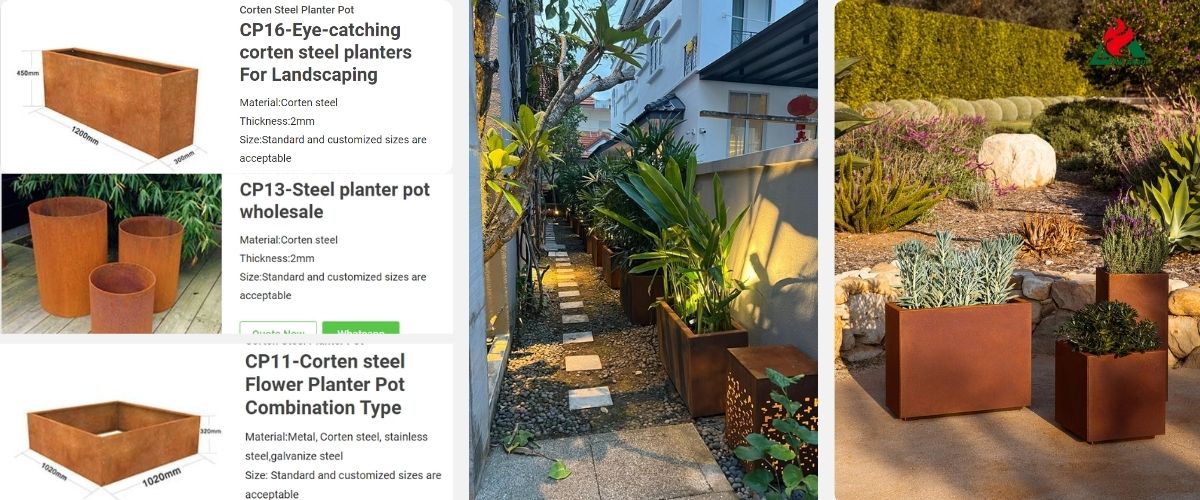
Garden corners: Use tall, rectangular Corten steel planters to conceal exposed wall bases or pipes, transforming dead corners into landscape highlights.
Porch/Entrance Hall: Place a pair of slender, tall Corten steel planters to create a symmetrical layout, maximizing the sense of ceremony.
Garden Zoning: Rectangular Corten steel planters serve as “soft dividers,” separating relaxation areas from planting zones without obstructing views.
Corten Steel Planter Garden Arrangement Formulas
To encourage customers to purchase sets, we offer three classic arrangement schemes:
Scheme A: Staggered Height Arrangement
Combination: 1 90cm-tall Coton steel planter, + 1 50cm square Coton steel planter. Effect: Breaks visual monotony and creates a sense of vertical extension, ideal for corner patios.
Scheme B: Layered Matrix Method
Combination: 3 or 5 rectangular rusted steel planters of the same size, arranged along a wall. Effect: Strong sense of sequence; suitable for minimalist architecture or commercial building facades.
Scheme C: Natural Jungle Method
Combination: Arrange round Coton steel planters of varying diameters and square Coton steel planters of varying heights in an interlocking triangular pattern. Effect: Simulates the layered growth of nature, making the landscape appear fuller and more vibrant.
Reason 5: Style Adaptability — The “Style Chameleon” Quality of Corten Planters
The most captivating aspect of corten steel lies in its evolving color. It is not a static industrial product; its hue deepens or lightens in response to changes in environmental humidity and light, offering exceptional adaptability to various styles.
Style Pairings for Corten Planters
Modern Minimalist Style
Styling Tips: Choose rectangular or cubic weathering steel planters and plant linear foliage such as snake plants, horsetails, and needle grass. Visual Effect: The rusted metallic texture contrasts with clean architectural lines, creating an ultra-refined look.
Industrial Loft Style
Styling Tips: Pair rust-colored Corten steel planters with dark gravel, concrete surfaces, and black grating. Visual Effect: Enhances a vintage vibe, perfect for café porches or urban terraces.
Natural Garden Style
Styling Tip: Place Corten steel planters on a pressure-treated wood deck, surrounded by an abundance of ornamental grasses or groundcover flowers. Visual Effect: The warm orange-rust hue blends perfectly with the wood, appearing as if it grew directly from the earth.
Reason 6: Shaping Space — Corten Planters Define Garden Boundaries
Whether it’s a balcony measuring just a few square meters or a private estate spanning hundreds of square meters, Corten steel planters can impart a new sense of order to a space by varying their placement patterns.
Layout Solutions: Using Planters to Create a Sense of Boundary
Small Courtyards/Terraces: Maximize vertical space to clearly define boundaries
Vertical Strategy: Use columnar corten steel planters of varying heights in a staggered arrangement to create vertical visual depth within a minimal footprint.
Vertical Screen: Place elongated steel planters along boundaries and plant bamboo or tall ornamental grasses to instantly transform them into a “green curtain,” carving out private space within a crowded neighborhood.
Large Courtyards/Estates: Create Rhythm and Guide the Eye
Array Aesthetics: Arrange multiple sets of large square Corten steel planters at equal intervals to guard entrances or driveways like soldiers, creating a commanding presence.
Landscape Rhythm: Use Corten steel planters as “visual anchors” to guide guests toward seating areas or the pool across open lawns.
Reason 7: Versatile Planting — Corten Planters Suit All Plants
Corten steel planters are not only works of art but also high-performance planting containers. Their thick steel plates effectively buffer sudden temperature changes, providing a stable growing environment for plant roots.
Suitable Plants: Versatile Planting Compatibility
Seasonal Flowers: Such as hydrangeas and tulips. The warm tones of Corten steel perfectly complement the vibrant colors of the flowers, enhancing their visual appeal.
Ornamental Grasses: Such as pink pampas grass and slender silver grass. Rusted steel planters are typically deep, making them ideal for ornamental grasses with extensive root systems to create a “wildland aesthetic.”
Herbs/Shrubs: Such as rosemary, lavender, and boxwood balls. Ideal for placement near easily accessible dining areas, combining practicality with aesthetic appeal.
Small Trees: Such as red maple and olive trees. Large Corten steel planters with a depth of 60 cm or more can accommodate medium-sized woody plants, serving as a visual focal point in the garden.
Care Tips: Simple Maintenance Techniques for Planters
Light: Corten steel conducts heat quickly. In strong summer sunlight, increase watering frequency to prevent the soil from drying out.
Drainage: The bottom must have drainage holes, and a layer of expanded clay pellets should be placed to prevent waterlogging and root rot.
Seasonal Repotting: Add organic fertilizer every spring and partially replace the topsoil every 2–3 years to maintain soil fertility.
Reason 8: Premium Aesthetic — Corten Planters Enhance Garden Value
In landscape design, the substantial feel of materials determines the sophistication of a space. Placing outdoor planters in key locations can instantly elevate the visual value of a property.
Entrance Foyer: A pair of tall, symmetrical corten landscape planters greet guests like sentinels, establishing a first impression of “neatness and dignity.”
Patio Dining Area: The enclosed design of Corten steel planters defines a separate outdoor dining space, enhancing privacy.
Commercial Applications (B2B): Ideal for outdoor displays at bed-and-breakfasts, cafes, and art galleries. Corten steel’s impact resistance and weather resistance make it a top choice for high-traffic commercial spaces.
Reason 9: Easier Maintenance—Say Goodbye to Hassles, Say Hello to Gardening Joy
Many people have a misconception about corten steel, believing that “rust” equals “dirt” or “deterioration.” In fact, this rust layer serves as a “protective coating” that makes maintenance exceptionally easy.
Daily Guide: Debunking Common Planters Maintenance Myths
Myth Busted: The rust layer on Corten steel is a dense oxide film that not only prevents decay but becomes stronger over time.
Initial Rust Prevention: Before the rust layer fully stabilizes (within the first 3–6 months), a slight rust-colored runoff may seep out after rain. It is recommended to place the planter on a dark surface or a gravel base to prevent staining the ground.
Cleaning Frequency: Generally, no cleaning is required. If the dust accumulates heavily, simply rinse with clean water.
Drainage Check: Inspect the drainage holes quarterly to prevent them from becoming clogged by plant roots.
Key Considerations: Planter Thickness and Structural Selection
Thickness Standards: For small Corten steel planters for home use, a thickness of 2 mm is recommended; for large or commercial projects, a thickness of 3 mm or more is recommended.
Key Point: Check for internal reinforcing ribs. Large rectangular planters without internal support are prone to bulging and deformation when filled with soil.
Drainage and Liners: Practical Configuration Recommendations
Drainage Holes: Must be present. We do not recommend choosing large metal pots without drainage holes, as standing water can lead to metal oxidation byproducts that harm plant roots.
Liner Selection: For plants that are extremely sensitive to pH levels, we recommend using a polystyrene liner; in extremely cold regions, it also provides insulation.
Q1: Will the planter stain light-colored surfaces? There may be a slight impact, but it can be prevented. During the initial rusting phase (3–9 months), rainwater may wash away a small amount of rust dust. Solution: Place a drip tray under the planter; or position it on gravel, grass, or dark-colored paving. Once the rust color has stabilized, there will be virtually no further color transfer. Q2: How long does it take for the planter’s rust color to stabilize? It depends on the climate and environment. In humid, rainy regions, a dense protective layer typically forms within 3–6 months; in dry regions, it may take up to a year. We offer a “catalyzing spray” to help you achieve the ideal rust color within one week. Q3: Does the planter require a liner or drainage layer? A drainage layer (such as expanded clay or gravel) is strongly recommended. As for liners, Corten steel is generally plant-friendly; liners are only necessary in extremely cold regions or when planting specific types of plants. Q4: Is the planter suitable for year-round outdoor use? Yes. Corten steel was originally designed for bridges and construction. Compared to brittle plastic pots or rot-prone wooden pots, Corten steel planters have a lifespan of 20–50 years or even longer, making them perfectly suited for year-round outdoor use. Q5: How do I clean the planter’s surface? Never use chemical cleaners! Simply rinse off the dust with clean water. If scratches appear, there’s no need to worry—it has a “self-healing” property. Over time, a new layer of rust will form over the scratches, blending seamlessly with the rest of the surface. Q6: How should I choose a planter for rainy regions? We recommend selecting Corten steel planters with a thickness of 3mm or more. Also, ensure the drainage holes at the bottom are enlarged and use a raised base to prevent the bottom from being submerged in water for extended periods. Ready to Choose Your Perfect Outdoor Corten Steel Planters? The 9 core advantages of rusted steel planters—timeless rust patina, exceptional weather resistance, plant protection, enhanced visual depth, style versatility, space-defining design, all-purpose planting, premium texture, and low-maintenance care—make them the ultimate investment for your garden. This is not just an ordinary planter; it is a work of art that coexists with your garden, developing a unique beauty over time. It eliminates the hassle of frequently replacing planters while continuously enhancing the style and value of your garden. Browse our Corten planter collection and schedule a free design consultation to let this “work of art through time” infuse your garden with lasting vitality and beauty. Contact us now!

.jpg)
 Fill In The Inquiry