Will a Corten Steel Firepit Crack or Warp in Freeze-Thaw Climates
Date:2026.05.25
Share to:
In northern North America, high-latitude regions of Europe, and the frigid northern areas of China, winter temperature fluctuations between day and night are extreme, and repeated freeze-thaw cycles are the primary cause of damage to outdoor landscape materials. The alternating conditions of snow and ice melting during the day and freezing at night can cause water to expand by up to 9% in volume.
This invisible expansion stress is extremely powerful, capable of splitting hard stone and rupturing concrete foundations. It also raises two major concerns regarding the use of weathering steel fire pits placed outdoors.
Most homeowners and landscape designers worry about two key issues when purchasing these products: Will extreme cold—with temperatures dropping to dozens of degrees below zero—combined with the pressure of snow and ice, cause the rusted steel fire pit to crack and become unusable? When a fire is lit on a cold winter night, will the instantaneous contact between 600°C heat and snow or ice cause the steel plate to permanently warp or deform?
Substandard fire pits produced by small workshops—made from ordinary black iron, thin steel plates, and crude welding techniques—are indeed highly prone to weld seam tearing and plate deformation during their first winter.
As a professional brand with 20 years of expertise in high-end corten steel manufacturing and serving global engineering projects, AHL combines materials science with practical engineering experience to thoroughly analyze the freeze-thaw resistance principles, causes of damage, and scientific protection solutions for fire pits, helping users avoid common pitfalls in material selection, installation, and usage.
1. Cold- and Deformation-Resistant Corten Fire Pit Material
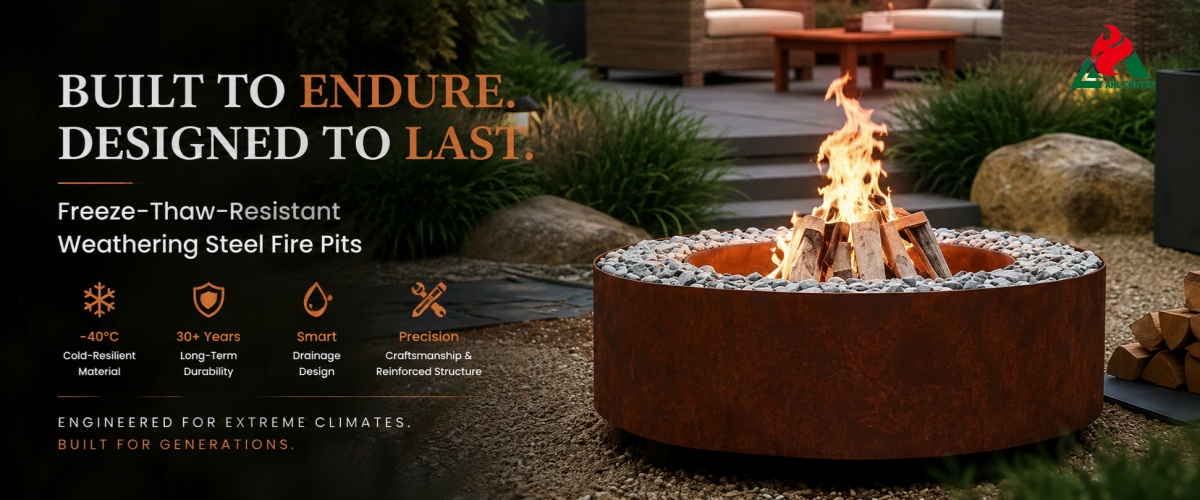
Genuine, high-quality SPA-H grade weathering steel offers excellent low-temperature impact toughness and high-temperature yield strength. Even in extremely cold environments of -40°C, it does not suffer from the cold-brittle fracture issues common in ordinary steel, making it fully capable of withstanding extreme freeze-thaw cycles and thermal shock at the material level. Many people mistakenly believe that cracks and deformation in rusted steel fire pits are defects in the weathering steel material, but this is a misconception. Meeting material performance standards does not guarantee trouble-free use of the finished product.
2. Core Causes of Product Damage: Structural and Manufacturing Defects
In freeze-thaw climates, 90% of a weathering steel fire pit’s service life depends on the factory’s stress-resistant structural design, sheet thickness, welding techniques, as well as on-site drainage and installation details. Rusting is unrelated to damage; structural rigidity, drainage design, and installation methods are the critical factors.
3. Clear Criteria for Distinguishing High- and Low-Risk Products
Low-Risk Durable Models (30+Year Long-Term Durability): The core heat-exposed areas use 3.0mm, 5.0mm, or even 8.0mm industrial-grade thickened weathering steel fire pits; standard micro-sloped drainage channels; multi-layer folded edge reinforcement and built-in hidden frames; seamless, full-penetration welding using copper-chromium-nickel alloy weathering steel electrodes, combined with stress-relief annealing; installed on a gravel permeable layer or frost-resistant concrete base, with expansion joints provided for thermal expansion and contraction.
High-Risk, Vulnerable Models (Prone to Breakage in the First Year): Made of 1.5–2.0 mm ultra-thin steel sheets with low thermal capacity and poor stress resistance; flat bottom with no slope and no convection drainage structure; spot-welded with ordinary carbon steel electrodes, resulting in porosity and slag; installed directly on soft soil, loose subgrade, or flush against a wall.
Corten Fire Pit Freeze-Thaw Cracking & Deformation Mechanisms
1. Ice Crystal Expansion Stress: The Root Cause of Cracking and Bulging
During winter, when snowmelt or rainwater enters the round fire pit, stagnant water accumulates inside if the bottom is flat with no slope or if drainage holes are blocked by ash. As nighttime temperatures plummet below 0°C, the water rapidly freezes and expands, generating thousands of pounds of static pressure.
This sustained compressive stress acts like an invisible jack, repeatedly pushing outward against the fire pit’s side walls and bottom. Under long-term cyclic stress, the thin steel bottom will bulge downward, and the rough weld seams will be continuously pulled, eventually leading to structural tearing and cracking.
2. Extreme Temperature Gradient: The Culprit Behind Permanent Bending Deformation
When the fire pit is lit on a cold winter night, the temperature in the heated area inside the pit can soar to 600°C within half an hour, causing the metal molecules to expand violently due to heat. However, the outer walls and bottom of the fire pit remain in contact with ice, snow, and frozen soil, causing them to contract due to low temperatures.
When the steel plate is subjected to such extreme temperature differences—spanning hundreds of degrees Celsius—it generates severe thermal stress that leads to tearing. Without a scientifically designed bent structure to distribute the stress, the steel plate will continue to bend toward the colder side, eventually resulting in irreversible damage such as curled edges, warped surfaces, and loss of roundness.
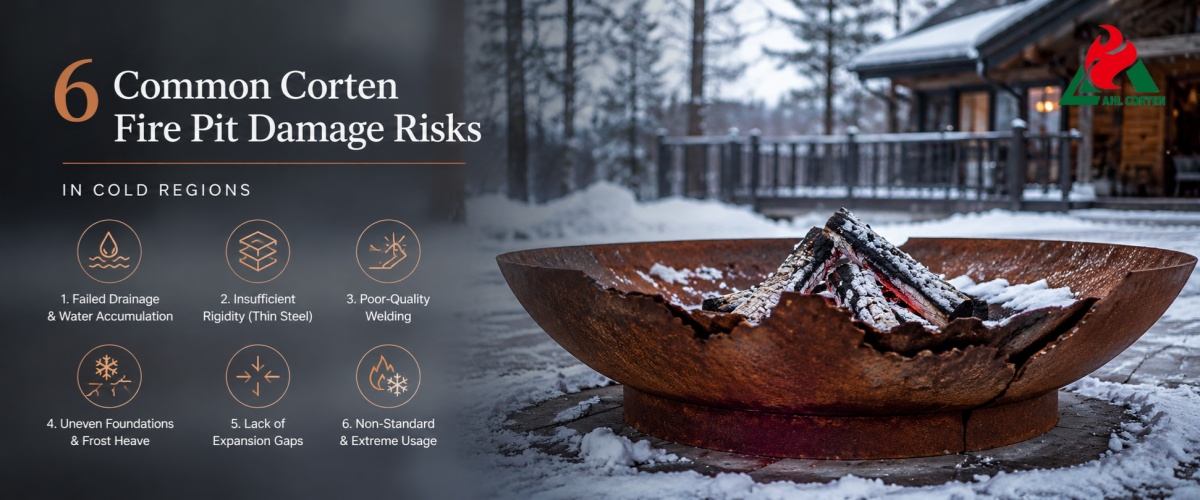
6 Common Corten Fire PitDamage Risks in Cold Regions
1. Failed Drainage and Water Accumulation
The absence of drainage holes, drainage holes that are too small, or holes prone to clogging with ash can turn a corten steel fire pit into a sealed water reservoir during winter. The “chipping effect” caused by repeated freeze-thaw cycles day and night rapidly tears apart welds, making this the primary cause of fire pit failure in cold regions.
2. Insufficient Structural Rigidity Due to Thin-Gauge Steel
Large-diameter rusted steel fire pits constructed with ultra-thin 1.5–2.0 mm steel plates suffer from extremely poor overall thermal capacity and structural rigidity. Unable to withstand the alternating stresses of thermal expansion from open flames and cold contraction from ice and snow, the flat-plate structure—lacking flanges or a supporting frame—is highly prone to buckling, warping, and deformation.
Small workshops use ordinary carbon steel electrodes for spot welding, leaving significant residual internal stresses in the welds, which lack weather-resistant alloy components. During freeze-thaw cycles, the welds are prone to intergranular corrosion, becoming the weakest fracture points in the entire structure.
4. Uneven Foundations and Freeze-Thaw Settlement
When placed directly on native soft soil or loose sand layers, uneven freeze-thaw expansion occurs during winter as the soil absorbs water and freezes. The fire pit bears weight on one side while the other side is suspended, forcing the entire frame to twist and completely destroying its geometric structure.
5. Lack of Expansion Gaps
When rigidly installed flush against granite or concrete walls without any expansion gaps, stress cannot be released during thermal expansion or when compressed by ice and snow. This directly leads to dents, wrinkles, or even fractures in the corten steel fire pit surface.
6. Non-Standard and Extreme Usage
Igniting a fierce fire directly in sub-zero temperatures, dousing with cold water after high-temperature use, or burying under snow for rapid cooling—all cause metal molecules to expand and contract rapidly, triggering irreversible cracking and deformation.
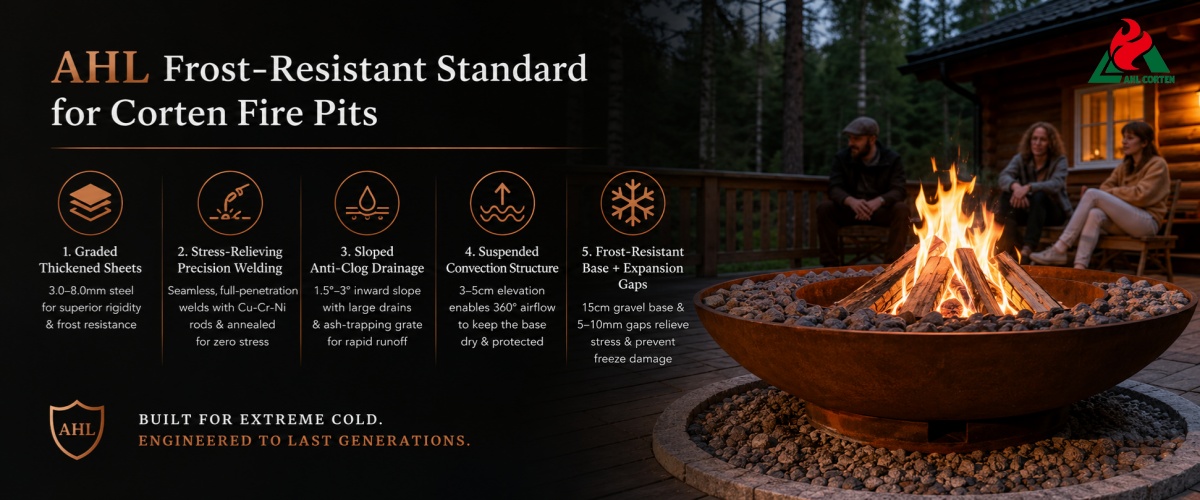
1. Graded Thickened Sheets for Enhanced Structural Rigidity
Moving away from a uniform thin-sheet process, the core heat-exposed areas of metal fire pits in frigid regions use steel plates no thinner than 3.0 mm, while large-scale municipal landscape models are upgraded to 5.0–8.0 mm. Combined with multi-layer folded edges, cold-rolled rolled edges, and built-in physical reinforcing ribs, this design firmly locks the structural form in place, resisting thermal stress and frost heave pressure.
Using specialized weather-resistant welding rods containing copper, chromium, and nickel, we perform double-sided, full-penetration, seamless welding. After welding, the entire unit undergoes annealing in a furnace to relieve residual stresses, completely eliminating potential hazards. This ensures the tensile strength and ductility of the welds match those of the steel plate itself, making them impervious to the pulling forces of ice and snow.
3. Slightly Sloped Anti-Clog Drainage, Eliminating Water Accumulation and Icing
The base abandons a completely flat design in favor of a 1.5°–3° inward-sloping drainage channel. Combined with large-diameter drainage holes and a concealed ash-trapping grate, rain and snowmelt are rapidly drained within 30 seconds, eliminating the “ice bucket effect” caused by water accumulation and icing at its source.
4. Suspended Convection Structure for a Dry Base
Featuring multi-leg supports and a concealed anti-settlement base, the weathering steel fire pit is elevated 3–5 cm off the ground. This creates a 360° convection air-drying layer beneath, preventing prolonged contact with water and maintaining the metal’s moisture balance, thereby eliminating localized freeze-thaw damage.
5. Frost-Resistant Base + Expansion Gaps for Structural Stress Relief
The standard 15cm graded crushed stone permeable base rapidly drains melted snow and standing water. The embedded installation design ensures a mandatory 5–10mm expansion gap, providing space for stress relief during thermal expansion and contraction as well as pressure from ice and snow, thereby preventing structural damage caused by compression.
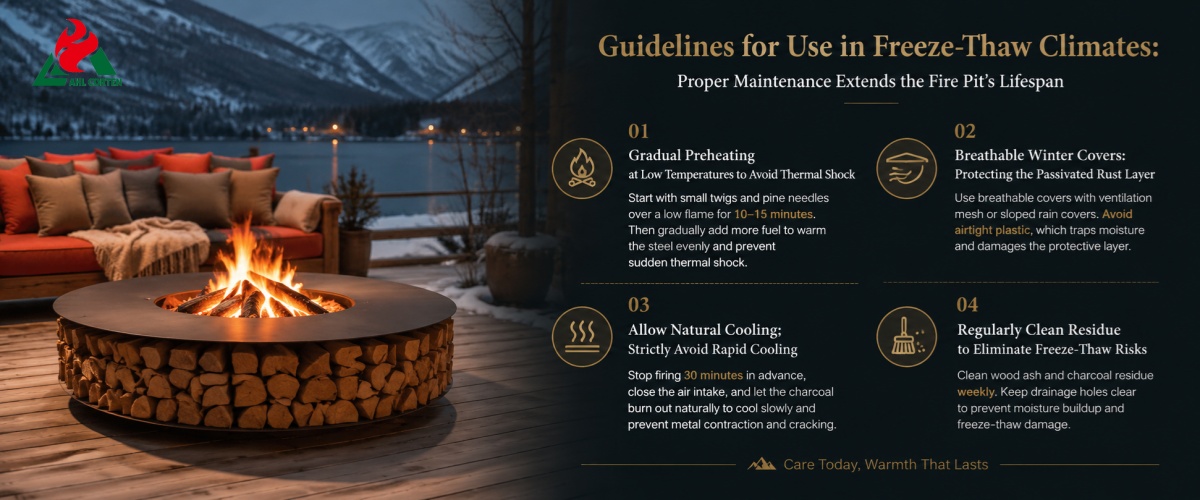
Guidelines for Use in Freeze-Thaw Climates: Proper Maintenance Extends the Fire Pit’s Lifespan
1. Gradual Preheating at Low Temperatures to Avoid Thermal Shock
When lighting the fire for the first time in sub-zero conditions, do not use a blowtorch or create large open flames. Start by preheating with small twigs and pine needles over a low flame for 10–15 minutes to allow the steel plate to warm evenly and undergo flexible thermal expansion. Then gradually add more fuel to increase the temperature, preventing sudden thermal shock.
2. Breathable Winter Covers: Protecting the Passivated Rust Layer
When the metal fire pit is not in use for extended periods during winter or during heavy snowfall, it must be covered for protection. Do not use airtight plastic sheeting to seal it. An airtight environment creates a greenhouse effect, trapping moisture that damages the dense passivated layer of the weathering steel fire pit. We recommend using a breathable cover with ventilation mesh on all four sides, or a sloped rain cover made of the same material, which blocks snow while maintaining airflow.
After use at high temperatures, never pour cold water or pile snow on the surface to force cooling. Stop firing half an hour in advance, close the air intake, and allow the charcoal to burn out naturally so the steel plate cools slowly. This prevents rapid contraction of the metal lattice, which can cause cracking.
4. Regularly Clean Residue to Eliminate Freeze-Thaw Risks
Wood ash and charcoal residue are highly hygroscopic; long-term accumulation absorbs moisture, forming a persistently damp layer. Clean residue from the pit bottom weekly to keep drainage holes clear and prevent localized freeze-thaw damage.
Project Risk Self-Check: Quickly Determine if Your Fire Pit Is in a High-Risk Freeze-Thaw Environment
Conduct a quick five-point self-inspection to accurately assess project risks, select the appropriate slab thickness and installation plan in advance, and avoid costly repairs and damage later on. 1. Site Climate: Is the location in a high-latitude or high-altitude area with frequent day-night freeze-thaw cycles and heavy snowfall? 2. Placement Surface: Is the fire pit placed directly on damp soil or grass, resulting in a consistently high-humidity environment at the base? 3. Product Structure: Does it feature a flat bottom design, lack sloped drainage channels, have small drainage holes, or lack drainage features? 4. Maintenance Habits: Does ash accumulate over long periods during winter without being cleaned promptly? 5. Installation Environment: Is it installed directly against hard landscape walls or stone surfaces without any expansion gaps?
FAQ: Addressing Key Concerns about Corten Fire Pits in Winter Freeze-Thaw Cycles
1. Will a Corten Fire Pit Become Brittle and Crack in Low-Temperature Environments?
High-quality SPA-H weathering steel is specifically designed for harsh, cold-weather conditions and heavy loads. It maintains excellent ductility and impact resistance even in extreme cold down to -40°C. It can absorb ice crystal pressure through slight elastic deformation, avoiding the low-temperature brittle fracture issues common in ordinary carbon steel.
2. Will Freeze-Thaw Cycles Damage the Rust-Protective Layer on Corten Fire Pits?
The dense rust layer formed under normal wet-dry cycles acts as a protective armor for the steel. However, prolonged water accumulation or an oxygen-deprived environment caused by complete freezing can lead to flaking of the rust layer. As long as proper drainage and ventilation are maintained to ensure normal wet-dry cycles, the rust layer will become denser over time, continuously enhancing its protective effectiveness.
3. Why Are Welds the Most Vulnerable Areas in Substandard Structures?
Non-specialized welding rods and spot-welding techniques leave significant residual internal stresses in the welds and result in material inconsistencies with the base metal. Under freeze-thaw stress, welds are the first to corrode and crack. AHL’s proprietary weathering steel welding and stress-relief processes can completely resolve these weld weaknesses.
4. Is It Necessary to Apply a Waterproof Sealant to Prevent Freezing?
It is completely unnecessary and not recommended. Ordinary sealants cannot withstand temperatures of 600°C or the alternating freeze-thaw cycles of extreme cold, making them highly prone to cracking and peeling. Moisture penetrating beneath the paint layer creates hidden damp zones that accelerate crevice corrosion. The core of scientific freeze protection lies in drainage, ventilation, and structural optimization.
5. What Is the Optimal Elevation for the Bottom of Fire Pits in Extremely Cold Regions?
We recommend raising the bottom by 3–5 cm. This not only prevents direct compression from frost heave but also creates a convective air-drying layer that rapidly dries moisture at the base, thereby avoiding long-term moisture-induced freeze-corrosion.
6. How Can Existing Fine Cracks Be Repaired?
Immediately cease equipment operation. Use a stainless steel grinding disc to grind the cracks down to the metal substrate and create a V-groove. Repair the area using specialized weather-resistant welding rods, combined with the original manufacturer’s repair solution to induce uniform rust formation, thereby restoring structural strength and protective performance.
7. How Can Protection Be Upgraded for Dual Freeze-Thaw Environments in Coastal Areas?
Coastal salt fog combined with freeze-thaw cycles constitutes a C5-grade highly corrosive environment, where chloride ions accelerate the degradation of the rust layer. We recommend upgrading to 5.0–8.0 mm thick plates and using 316 stainless steel for all fasteners to significantly extend service life in extreme environments.
Conclusion: Are You Ready to Choose the Perfect Fire Pit For You?
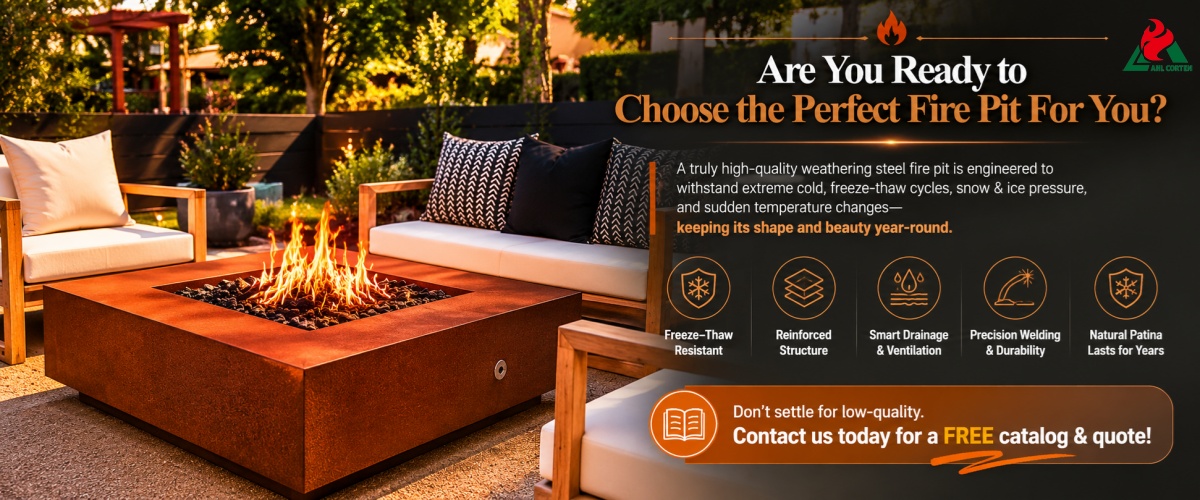
Ultimately, issues such as cracking, warping, and damage in weathering steel fire pits under freeze-thaw conditions are never due to insufficient cold resistance of the material itself, but rather avoidable wear and tear caused by poor-quality thin-plate construction, shoddy welding techniques, improper installation, and incorrect maintenance practices. A truly high-quality weathering steel fire pit, through scientific structural reinforcement, precision stress-relief welding, rational drainage and ventilation design, and standardized construction, can fully withstand extreme cold, freeze-thaw cycles, snow and ice pressure, and sudden temperature changes, maintaining its neat shape and natural, vintage rusted finish year-round.
Don’t want your outdoor fire pit to warp, crack, or require repairs and replacements after just its first winter? Stop blindly choosing low-cost, substandard products from unprofessional workshops! Contact us today for a free catalog and quote!


 Fill In The Inquiry